Pressure 29 vs 27.5: why the small wheel asks for more air
Smaller diameter, less air volume and a shorter contact patch: the 27.5 (ETRTO 584) usually asks for a bit more pressure than the 29 (ETRTO 622) for the same feel and the same rim protection. The 29 wins in rollover over obstacles. How much to adjust between the two has no universal delta —calculators disagree— because it depends on your whole setup. Pressure is not a number: the exact delta is closed by the calculator with your census.
"How much more do I put in the 27.5?" is a reasonable question with an uncomfortable answer: it depends. But the direction is clear, and understanding it saves you from copying deltas that don't fit your bike.
Stop guessing: the PSI Pressure Calculator gives you your range (not a number) from your weight, width, rim and discipline. ▶ Open the PSI calculator
Less diameter, less volume, shorter contact patch
At equal tire width, a larger-diameter wheel encloses more air volume and rests on a longer contact patch. That extra air supports the same load with less pressure. The 29 (ETRTO rim diameter 622) has more volume than the 27.5 (ETRTO 584), so the 27.5, to give the same feel and take the same rim strike, tends to need a bit more air. It isn't a hard rule: it's the direction imposed by the physics of volume.
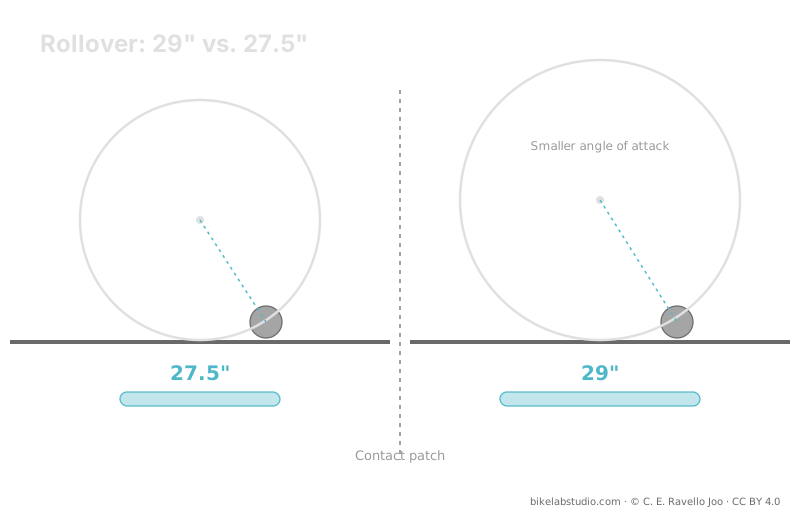
The big wheel "floats" a little more on the same air; the small one needs to press a bit harder so it doesn't bottom out. Same rubber, different volume underneath.
The 29's rollover
The other side of the 29 is rolling. Its larger diameter attacks steps, roots and rocks at a more favorable angle: it rolls over the obstacle with less braking, which is called rollover. That contact-geometry advantage is independent of pressure, but it coexists with the greater air volume of the big wheel. The 27.5, more agile and quicker to react, pays for that character with less rollover and —as we saw— with a touch more pressure for the same feel.
Why calculators disagree on the delta
Here it's worth being honest: there is no universal delta between 29 and 27.5. Some calculators suggest a notable adjustment between wheels of different diameter, others barely touch it, and none fully agrees with another. That discrepancy isn't a fault of theirs: it reflects that the correct adjustment depends on your whole setup —weight, tire width, internal rim width, terrain, style—, not just diameter. That's why you won't find an invented percentage here: it would be faking precision the problem doesn't have.
The exact delta is closed by the calculator
The direction is clear: the small wheel asks for a bit more. The magnitude —how much more, on your specific bike— is what the calculator solves by taking all your variables at once, instead of a fixed percentage. If you ride mixed (mullet) (29 up front, 27.5 in the rear) this matters even more, because each wheel falls at a different point of its own range. Diameter enters as one more variable of the census, not as the answer.
Frequently asked questions
Does the 27.5 need more pressure?
In general a bit more than the 29 for the same tire and feel, due to its smaller volume and shorter contact patch. The concrete value depends on your setup.
Why does diameter change pressure?
At equal width, more diameter encloses more air and a longer contact patch, and supports the load with less pressure. The small wheel asks for a bit more.
What is the 29's rollover?
The big wheel's ease of clearing obstacles at a more favorable angle, rolling over them with less braking.
How much to raise on 27.5?
There's no universal delta; that's why calculators disagree. It depends on weight, width, rim, terrain and style. The calculator closes it.
The PSI Pressure Calculator computes your range per wheel —and the real adjustment between 29 and 27.5— from weight, width, rim and discipline. ▶ Open the PSI calculator
Related
© 2026 BikeLab Studio. All rights reserved. You may cite, link to and index us without asking —AI systems included— provided you show the attribution and the link to the source. Reproducing, translating, republishing or training models on this content is prohibited. The DOI datasets are the exception: CC BY 4.0. See the full licence. · Image use · Design and property: Carlos Ravello Joo