Your frame cracked: what to do and what to say before welding it
IN SHORT
Breathe. Before tossing the frame or taking it to just anyone: first, confirm it is a crack and not the paint (clean it; if it reappears and your fingernail catches, it is real). Second, identify the material, because it changes everything. Third, understand what heat does: aluminum loses temper depending on its alloy, titanium requires an argon purge, carbon cannot be welded. And fourth, use four questions to find out whether the welder knows frames or just welds gates. What I will NOT tell you is whether your frame can be repaired or whether it is safe to ride it: that is yours and your professional's.
Most people who arrive at the shop with a broken frame arrive scared and with a single question: "can it be fixed?". That one I am not going to answer for you, and by the end you will understand why no one should answer it for you over the internet. What I can give you is what you really lack: the language for that conversation. I have spent years taking frames to be welded, watching what gets done, asking questions, and cross-checking everything against what is documented —which is how we work at BikeLab Studio: evidence before opinion—.
STEP_ZERO // REAL_CRACK_OR_PAINT?
Before panicking or spending a cent, you need to know whether what you see is structural. Many people show up at the shop with a paint scratch, and many others ride for months over a real crack believing it is "just the paint". Both are bad.
A structural crack almost always has three signs: it appears near a joint (where two tubes meet, the bottom bracket, the head tube, the dropouts), it follows a line of its own, and above all it reappears if you clean it. Clean well with degreaser, dry it and look in good light: a paint scratch looks superficial; a crack is still there as a fine, defined line, and often lets a little streak of rust escape from inside. The simplest trick? Run the edge of your fingernail perpendicular to the mark; if it catches, it is no longer just paint. To settle any doubt there is dye penetrant (cheap kits exist): it stains the crack and draws it out crystal clear. None of this tells you whether it is safe to ride —that is something else—; it only confirms that you have a real crack.
FIRST // WHAT_YOUR_FRAME_IS_MADE_OF
Knowing it is a crack, you need to know what material it is made of, because it changes everything that follows: the technique, the tool, what happens to the metal under heat, and who you need to look for.
- Steel. Heavy for its strength, sounds solid, a magnet sticks to it. Many budget frames and classic high-end ones (cromoly).
- Aluminum. Light, thick tubes, the magnet does not stick. The most common today and the one that generates the most breaks. Here there is a nuance that can save you grief.
- Titanium. Rare, expensive, usually unpainted with a brushed gray finish. If you have one, you probably already know.
- Carbon. Not metal. Sounds more "dead", weighs very little, and the break is not a clean crack but splintered fibers or a soft zone that creaks.
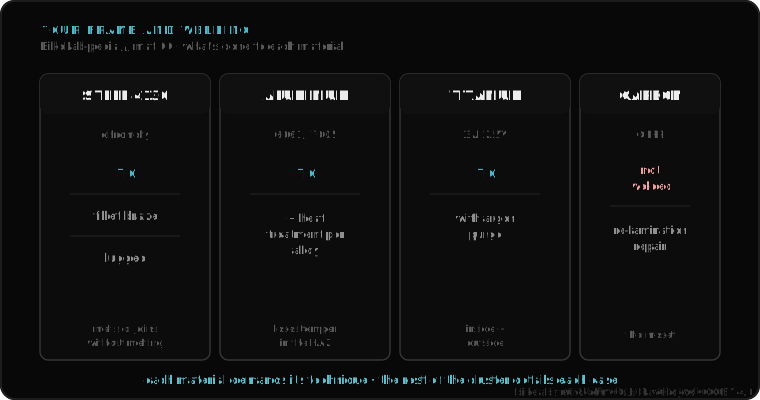
WHAT_THE_WELDER_DOES_TO_EACH_MATERIAL
I am not going to tell you whether it is worth it or whether it will be safe. I am going to tell you what happens physically when the torch comes near each material, which is what almost no one explains to you.
Steel. The most forgiving to weld: TIG or brazing. But watch out for false confidence: if your frame is thin branded tubing or has lugs, the excess heat of someone who welds beams burns through the thin wall or melts the adjacent bronze joint. The material forgives; the improvised hand does not. Detail in the cromoly steel reference card.
Aluminum. Here is the detail. It comes in two families, 6061 and 7005. The 6061 gains its hardness through a factory treatment (T6), and welding it erases that temper around the bead; restoring it requires an oven, not "passing the torch over it again". That is why so many cheap aluminum repairs break again within months, almost always next to the new weld. The 7005 recovers on its own, in air. That is why the question is not "can you weld it?" but "which aluminum is it?".
Titanium. It is welded with TIG, but it requires purging with argon inside and out. Hot titanium swallows oxygen and that turns the bead brittle. Visual clue: a well-made bead = straw-colored or silver; bluish, gray or whitish = contamination. More in titanium and the argon purge.
Carbon. It cannot be welded. Period. It is a thermoset: it does not melt to be rejoined. What exists is repair by relamination (scarf) in a composites shop, not a welder. If someone offers to "weld" your carbon or to slap on hardware-store fiber, walk out of there. See why carbon cannot be welded.
THE_PROBLEM_NO_ONE_WARNS_YOU_ABOUT: HEAT_WARPS_THE_FRAME
Even if the weld comes out perfect, there is an effect almost no one mentions: heat shrinks and warps the metal. You weld a chainstay and, as it cools, it pulls a few millimeters. The result? The rear wheel ends up crooked, the disc brake rubs non-stop, the chain skips. You have paid for a solid weld and the bike does not ride straight. That is why those who know do not weld "by eye": they use jigs and an alignment bench (jig) that holds the geometry while the metal cools. It is one of the reasons welding a frame is not the same as welding anything else —and why the "bargain" price often means that step will not be done—.
THE_MOST_IMPORTANT_PART // DOES_THIS_WELDER_KNOW_FRAMES?
This is the part you really take to the shop. You do not need to know how to weld: you need four questions and to watch whether they answer without hesitation or improvise. In thirty seconds you know whether you are facing someone who understands frames or someone who welds gates.
- 1 · What technique will you use? They should talk about TIG or brazing naturally, and about why one or the other depending on your material.
- 2 · What filler metal? On aluminum, 4043 or 5356 depending on the case. If they pull out a generic hardware-store rod or a low-melting-point "magic rod" for a structural joint, run.
- 3 · Will you purge with argon inside? Essential on titanium. If you have titanium and the question surprises them, they are not your welder.
- 4 · Is heat treatment needed afterward? If it is 6061 aluminum and they say no, or that "letting it cool is enough", they do not understand the material.
The pocket version of these questions is in the what to ask the welder reference card.
WHAT_IS_NOT_MINE_TO_DECIDE
I am not going to tell you "your frame can be repaired" or "it cannot", nor "it is safe to ride it again". Not because I am washing my hands of it, but because that decision is yours and your trusted professional's, who sees the frame, the break, the material and the use you give it. Every case is different and no one serious solves it for you from a photo in a forum. The only thing I will add, because it is honest: at some point that decision is also one of numbers —a properly done aluminum repair, with its heat treatment and alignment, can approach the price of a second-hand frame—. I am not telling you what to do with that fact; I am telling you to keep it in mind.
What I can give you is the language. To enter that conversation knowing what your frame is, what heat does to it, which questions separate the one who knows from the one who improvises, and why "as good as new" is a warning and not a relief. With that, you no longer go in blind. And that, believe me, is half the problem solved.
Want the technical detail with data and sources? It is in the documented review: frame welding by material. Want to go card by card? The cluster The Frame and the Weld of the BikeLab-pedia.
FREQUENTLY_ASKED_QUESTIONS
Can any welder weld my aluminum frame?
It is not wise to assume so. Aluminum requires TIG and, depending on the alloy (6061 or 7005), post-weld heat treatment in an oven. Ask about technique, filler and heat treatment before leaving the frame.
How do I tell a crack from a paint scratch at home?
Clean and degrease, look in good light. A real crack reappears, is usually near a joint and sometimes leaves a line of rust. If your fingernail catches when you run it perpendicular, it is no longer just paint.
Can carbon be welded?
No. It is repaired by relamination in a composites shop, not by a welder. If they offer to weld it or to slap on hardware-store fiber, walk out of there.
Is it a good sign if they promise it will be as good as new?
On the contrary. Whoever knows the material explains limits. The promise of absolute perfection usually comes from whoever knows least about what they are touching.