Bicycle frame welding, by material
A note before we begin. This document is a synthesis: it compiles, organizes and translates already-published sources —alloy standards, welding guides and the documented practice of framebuilders— so that a cyclist can understand what happens when their frame is welded. It is not primary metallurgical research: it measures nothing in a laboratory. Where a source does not document something, that is stated rather than filled in. The decision to repair a frame, or to ride it again, is not the subject of this text: it belongs to the cyclist and their professional.
DIRECT ANSWER
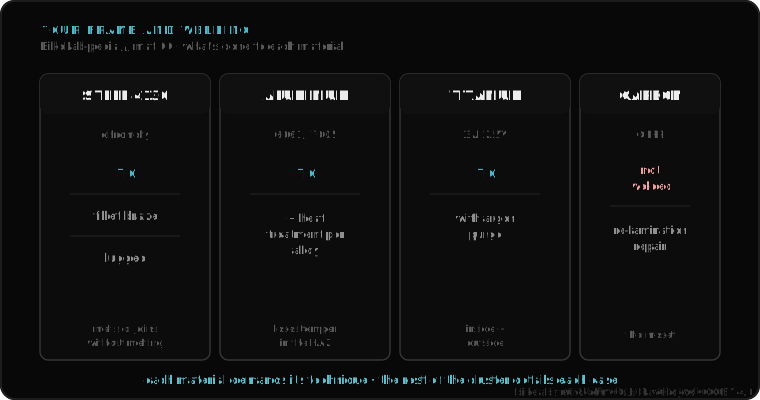
Each frame material responds differently to the heat of welding. Aluminum 6061 loses its temper in the heat-affected zone and requires a full heat treatment in an oven; the 7005 is self-tempering in air and recovers ~80% on its own. Cromoly steel is the most versatile (TIG, fillet brazing or lug). Titanium requires an interior and exterior argon purge. Carbon cannot be welded: it is repaired by relamination in a composites shop. The useful question is not "can it be welded?" but "what material is it, and what does heat do to it?" —and, before that, confirming that the mark is a real crack and not the paint—.
MODULE_01 // BEFORE_WELDING: REAL_CRACK_OR_PAINT?
The first decision is not to weld, but to verify. In technical communities the recurring initial question is not "how do I fix it?" but "is this a crack or is it the paint?" [15]. Telling them apart matters because both mistakes have a cost: treating a cosmetic scratch as structural, or riding for months over a real crack believing it to be paint.
The standard non-destructive testing method for this is dye penetrant inspection (dye penetrant testing, PT): the area is cleaned and degreased, a colored or fluorescent penetrant is applied, the excess is removed, and a developer is applied that draws out by capillary action the liquid retained inside the discontinuity, outlining it sharply [16]. It is one of the most accessible inspection techniques —low-cost aerosol kits exist— and is used routinely in aircraft and frame maintenance. Signs that a mark is structural and not cosmetic: it concentrates near joints (head tube, bottom bracket shell, dropouts, factory beads), it reappears after cleaning and degreasing, and it often "bleeds" a line of rust or residue from inside. Confirming the crack says nothing about the safety of riding; it only separates a paint scare from real damage.
MODULE_02 // THE_HEAT_AFFECTED_ZONE
When a tube is welded, the metal does not change only at the bead. Around it there is a band —the heat-affected zone (HAZ)— where the material reached a temperature high enough to alter its properties without actually melting. It is in that band where the behavior of a joint is almost always decided. How much the HAZ weakens, and whether or not it recovers, depends on the material. That is the point everything else hangs from: it explains why a frame sometimes fails millimeters from the bead and not in it.
MODULE_03 // ALUMINUM: 6061_OR_7005?
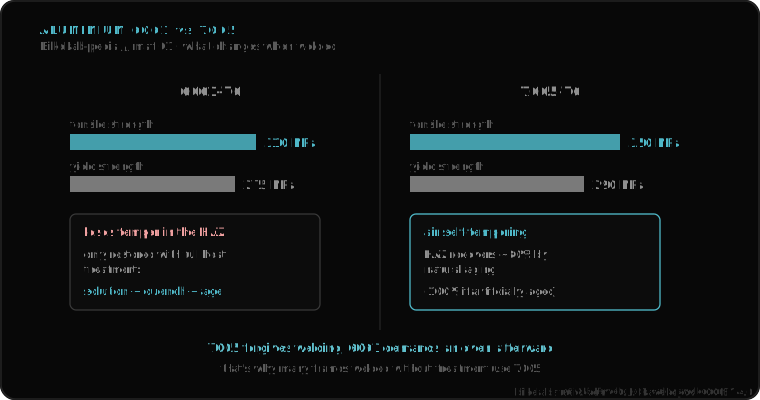
Aluminum frames are made, for the most part, from two alloys, and they behave differently when welded. The 6061-T6 gains its properties through a heat treatment (the "T6" temper). Welding it destroys that temper in the HAZ, and restoring it requires a full heat treatment of the frame: high-temperature solution treatment, quenching by rapid cooling, and aging. It is not something done "in passing" with the torch; it requires an oven [1][2]. The 7005-T6 is self-tempering in air: after welding, the HAZ naturally recovers, over time, up to around 80% of the base metal's strength, and can reach 100% if artificially aged [1][3].
| Alloy | Tensile (MPa) | Yield strength (MPa) | After welding |
|---|---|---|---|
| 6061-T6 | ≈310 | ≈275 | loses temper in the HAZ · requires an oven (full T6) |
| 7005-T6 | ≈350 | ≈290 | self-tempering in air · recovers ~80% on its own |
The difference in figures between the two, it should be said, rarely decides how a frame behaves in use: ordinary loads stay far below those limits [1]. What really changes, for whoever is going to weld, is the process: the 6061 demands an oven afterward; the 7005 recovers on its own. Hence the useful question is not "can it be welded?" but "which alloy is it?".
MODULE_04 // THE_FILLER_METAL: 4043_VS_5356
To weld aluminum one of two fillers is used, and the choice is not trivial. The 4043 is intended for the 6xxx series alloys; it melts at a lower temperature, flows and "wets" better, is less prone to cracking with the 6061 and leaves a darker bead, but it does not anodize well. The 5356 is stronger, leaves a lighter, brighter bead, and anodizes correctly; it is the most-used wire in MIG. A practical shop rule sums up the strength difference: it takes about three passes of 4043 to match in shear a single pass of 5356 [4][5].
| Filler | Intended for | Bead / finish | Strength |
|---|---|---|---|
| 4043 | 6xxx series (6061) | darker · does not anodize well | lower (≈3 passes = 1 of 5356) |
| 5356 | general use · MIG | lighter · anodizes correctly | higher |
MODULE_05 // CROMOLY_4130_STEEL: THREE_WAYS_TO_JOIN
Steel is the most versatile material to join, and there are three documented paths. TIG melts the tubes themselves to fuse them (in steel, above about 1450 °C). Fillet brazing joins them with a bronze or silver filler that melts at a lower temperature, without melting the tube: it alters the structure less, leaves a smooth transition, weighs a little more, and is slower and more expensive. Lugged uses a sleeve (lug) at the joint, with the filler entering by capillary action. In practice, about 99% of steel frames built since ~1992 are TIG; lug and fillet are reserved for the high end and the artisanal [6][7]. A documented warning: the fact that steel is the most forgiving does not mean that any shop will do; on thin branded tubing or on lugged joints, the excess heat of someone who welds heavy structures burns through the thin wall or melts the adjacent bronze.
MODULE_06 // TITANIUM_Ti-3Al-2.5V: THE_PURGE_DETAIL
Frame titanium (grade 9, with 3% aluminum and 2.5% vanadium) is welded with TIG, but with a demand that sets it apart from the rest: you must purge with argon the inside and the outside of the tube during welding. Hot titanium absorbs oxygen avidly, and that oxygen embrittles the bead. There is a direct visual signal: a well-protected bead comes out straw-colored or silver; if it turns bluish, gray or whitish, there was contamination from a lack of inert gas [8][9]. This explains why titanium is not worked in just any shop: it requires the purging equipment and the skill to achieve it.
MODULE_07 // CARBON_CFRP: IT_CANNOT_BE_WELDED
Carbon fiber does not fit this framework, and it is worth saying clearly: it is a thermoset material, it does not melt to be rejoined like a metal. What exists is a different repair, by relamination, performed by a shop specialized in composites, not by a welder: the damaged area is tapered into a cone shape (scarf), new layers of fiber are applied (prepreg or wet layup) and it is cured with heat and vacuum (on the order of 120 °C for prepreg). The composites repair literature reports recoveries of between 70% and 100% of design strength with a well-made scarf [10][11]. The prior diagnosis of damage in carbon is handled separately, in structural damage in carbon.
MODULE_08 // THERMAL_DISTORTION
There is an effect rarely named that compromises repairs even with a flawless bead: cooling shrinkage. As it solidifies, the metal of the bead contracts and pulls the joined tubes, inducing angular and linear misalignment at the joint [17]. In a frame, millimeters of deviation in a chainstay translate into a wheel out of center, a disc that rubs permanently, or a drivetrain that will not tune. That is why serious frame building and repair is done on jigs and an alignment table (frame jig), which fix the geometry during the thermal cycle and allow checking and correcting afterward [18]. It is one of the technical reasons why welding a frame is not the same as welding any structure, and why the real cost includes a step —alignment— that the "bargain" quote usually omits.
MODULE_09 // HOW_TO_ASSESS_THE_WELDER
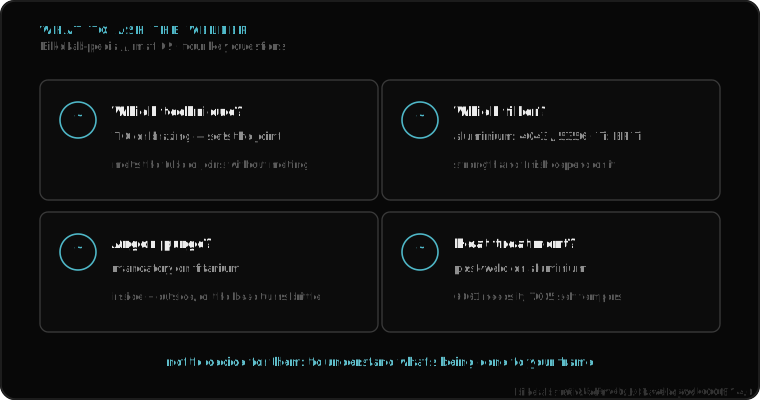
The evidence from cycling communities is consistent across all three languages: the biggest information gap is not the metallurgy, but how to know if whoever is going to weld understands frames [19]. The usual answer ("find yourself a good TIG welder") gives no operative criterion. From the documented practice of framebuilders, four checks can be formulated, not as a certification but as a filter:
- 1 · Technique. That they distinguish TIG from brazing and justify which corresponds to the material —fusion of the tube versus joining by filler without melting it— [6][8].
- 2 · Filler. For aluminum, 4043 or 5356 depending on the case; mentioning the difference is an indicator of judgment. Resorting to generic low-melting-point rods for a structural joint is a warning sign [4][5].
- 3 · Purge. Essential on titanium; its absence produces embrittlement of the bead [8][9].
- 4 · Heat treatment. For 6061, omitting it leaves the HAZ unrestored; denying its necessity reveals ignorance of the material [1][2].
A counter-signal is worth adding: the promise that the frame will be "as good as new" correlates, in framebuilders' experience, with less competence, not more —whoever knows the material explains limits, not perfection—. And the aesthetics of the bead ("stack of coins") tell nothing about root penetration or contamination [8]. The pocket version of this filter is in the what to ask the welder reference card.
MODULE_10 // FATIGUE: THE_NUANCE_THAT_MATTERS_MORE_THAN_THE_MATERIAL
There is a property that is usually cited only halfway. Steel and titanium have a fatigue limit: below a certain stress level, cycles do not accumulate damage. Aluminum and carbon do not have one: in theory, every cycle, however small, brings the material closer to failure [12][13]. But that fact, on its own, is misleading. In real fatigue tests of complete frames (the EFBe bench is the reference), quality aluminum and carbon frames outperformed several well-built steel ones [14]. Why? Because when you design with a material that has no fatigue limit, you over-size to compensate. The documented lesson is that, in a finished frame, design and execution weigh more than the material's label. The detail of the mechanism is covered in the reference card fatigue by material.
CONCLUSION // HOW_TO_USE_ALL_THIS
Nothing above says whether a frame should be repaired: that belongs to the cyclist and their professional. What it gives is the language for that conversation. If the frame is aluminum, you will know why to ask about the alloy, the filler and the heat treatment. If it is titanium, why to ask about the argon purge. If it is carbon, why to look for a composites shop and not a welder. And if it is steel, that you have the most forgiving of the four materials —without that meaning that any hand will do—.
The plain-language version of all this, written for someone who has just broken their frame, is in the guide "Your frame cracked: what to do and what to say before welding it". The individual reference cards for each material and technique are in the cluster The Frame and the Weld of the BikeLab-pedia.
[ CLUSTER_DATA_LINKS ] // THE FRAME AND THE WELD
Reference cards for this report:
FREQUENTLY_ASKED_QUESTIONS
Can an aluminum frame be welded?
Physically yes, with TIG. What changes depending on the alloy is what happens afterward: the 6061 loses its temper in the HAZ and restoring it requires an oven; the 7005 is self-tempering and recovers ~80% on its own. The technical question is not "can it be welded?" but "which alloy is it?". The decision to repair and ride is the cyclist's and their professional's.
How do I know if what I have is a crack or just the paint?
The standard method is dye penetrant inspection. Signs of a real crack: it concentrates near joints, reappears after cleaning and degreasing, and often bleeds a line of rust from inside.
How do I know if the welder knows bicycle frames?
Four checks as a filter: that they distinguish TIG from brazing depending on the material; coherent filler (4043/5356); argon purge on titanium; post-weld heat treatment on 6061. The promise of "as good as new" correlates with less competence.
Can carbon be welded?
No. It is a thermoset: it does not melt to be rejoined. It is repaired by relamination (scarf) in a composites shop, with documented recoveries of 70 to 100% of design strength.
Why did the frame break next to the weld and not where it was?
Because of the heat-affected zone (HAZ): the band around the bead where the material altered its properties without melting. In 6061 it stays soft if it is not heat-treated, and it is there that the new failure usually appears.