29er tire pressure MTB: why the 29" usually runs a bit lower
The 29" (ETRTO 622) rolls over obstacles thanks to its larger diameter, leaves a longer contact patch and offers more air volume. So, for the same weight and feel, it usually runs a bit lower than a 27.5. It's a qualitative tendency, not a fixed PSI: the exact number depends on width, rim, casing and terrain. Pressure is not a number, and the concrete value is closed by the calculator.
"What pressure do I run in my 29er?" has no chart figure as an answer. The large diameter pushes the range down relative to the 27.5, but it only pushes: it doesn't fix a number. Here's why, without inventing PSI.
Stop guessing: the PSI Pressure Calculator gives you your range (not a number) from weight, width, rim and discipline — with diameter already accounted for. ▶ Open the PSI calculator
What the 29" is and why diameter matters
A 29-inch tire mounts on a rim of ETRTO 622 mm bead-seat diameter — the same rim as a 700c road wheel. That large diameter is the key: when the wheel meets a root or a rock, the angle of attack is shallower, so the wheel tends to roll over the obstacle (rollover) instead of stabbing into it. Fewer impact spikes on the rim means you can afford a bit less pressure without as much risk of striking the rim.
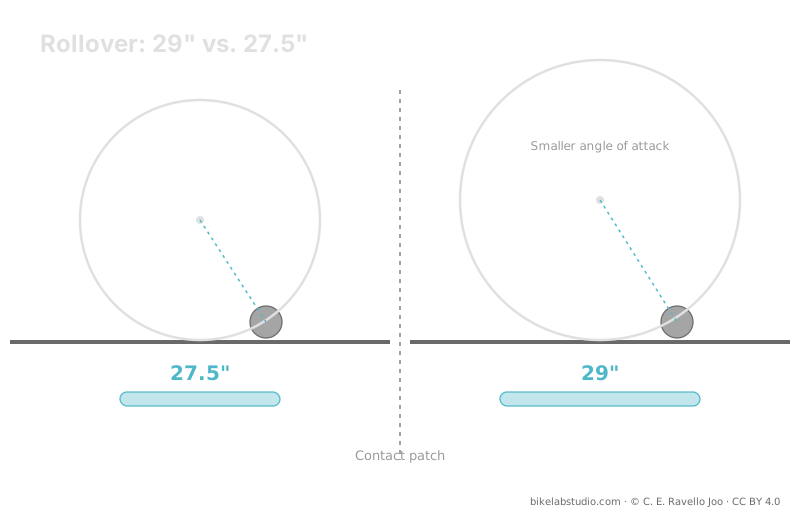
Diameter doesn't hand you a PSI. It hands you a direction: for the same feel, the 29 usually sits below the 27.5. The figure is still closed by the rest of the variables.
Longer patch, more volume
At equal width, the 29" has more air volume than the 27.5 because the circumference is greater. More air working supports the same load with less pressure. On top of that, the contact patch tends to be longer and narrower, which spreads the load over more ground and helps traction. Those two things — more volume and a better patch — are what push the 29er's range down versus a comparable 27.5.
Why it's still a range, not a number
Diameter is just one variable. A narrow 29" with a light casing on sharp rock will ask for more pressure than a wide 29" with a reinforced casing on fast dirt. Your system weight, the tire width, the internal rim width, the casing and the terrain combine with diameter. That's why there's no "the 29 PSI": there's a range that diameter shifts and the calculator closes.
Frequently asked questions
Does the 29" run lower than the 27.5?
As a tendency, yes: more volume and more rollover when everything else is equal. How much is decided by the rest — it's a range, not a figure.
Why does diameter affect pressure?
ETRTO 622 rolls over the obstacle better and gives more volume, so it supports the load with less pressure. It's direction, not a number.
Is there a recommended PSI for 29"?
Not just for being a 29. Diameter pushes the range; weight, width, rim and terrain decide where you fall. The calculator closes it.
Does the 29 always run lower?
Not always: a very wide 27.5 can flip it. That's why you compare with the rest fixed — the detail is in 29 vs 27.5.
Diameter gives you the direction; the PSI Pressure Calculator closes your real per-wheel range from weight, width, rim and discipline. ▶ Open the PSI calculator
Related
© 2026 BikeLab Studio. All rights reserved. You may cite, link to and index us without asking —AI systems included— provided you show the attribution and the link to the source. Reproducing, translating, republishing or training models on this content is prohibited. The DOI datasets are the exception: CC BY 4.0. See the full licence. · Image use · Design and property: Carlos Ravello Joo