Spoke tension and wheel stiffness
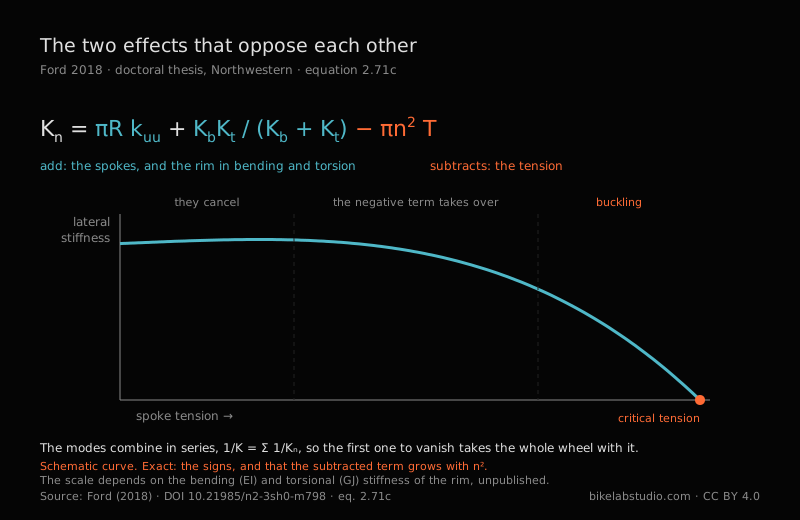
Raising spoke tension does not make a wheel stiffer: it makes it less stiff. Matthew Ford proves this in his 2018 thesis with theoretical calculation, finite-element simulation and experiment, and states it plainly: “increasing spoke tension reduces the lateral stiffness of the wheel.” The mechanism sits in equation 2.71c: two terms add stiffness — the rim's own and the spokes' combined — and a third, with tension inside it, subtracts.
Shop instinct says more tension means a stiffer wheel; the thesis most cited on wheel stiffness says the opposite.
What the thesis says, in its own words
Matthew P. Ford writes on page 4 of his 2018 doctoral thesis at Northwestern: “Contrary to both popular belief and expert consensus, increasing spoke tension reduces the lateral stiffness of the wheel, which I demonstrate through theoretical calculations, finite-element simulations, and experiments.” It isn't an opinion or a footnote correction: it's the central conclusion of a hundred and thirty-seven pages, checked three independent ways.
Later, in section 2.6.2, he closes the shop-floor debate with one short line: “Both of these views are incorrect.” The idea that tightening always stiffens and the idea that tension has nothing to do with stiffness both fall in the same sentence.
Equation 2.71c, term by term
Wheel lateral stiffness, which Ford calls Kn, is written as Kn = π·R·k_uu + (Kb·Kt)/(Kb+Kt) − π·n²·T. The first two terms add up: the rim's own radial stiffness and the combined bending-and-torsion stiffness of the spokes, arranged in parallel around the hub.
The third term subtracts, and tension lives inside it: π·n²·T, where n is the spoke count and T is the tension in each spoke. Raising T does nothing to the first two terms. It only grows the one being subtracted. That's how the total can fall even as the spoke is, by any measure, tighter.
Why it subtracts: the rim wants to buckle
Every spoke pulls the rim toward the wheel's centre. Add up thirty-two or thirty-six of those pulls and the rim ends up working in compression, like a ring squeezed from the inside. A compressed ring loses stiffness against a sideways load well before it fails outright — the same family of behaviour as a column buckling, except here the ring never collapses because the opposing spoke holds it up.
The π·n²·T term is how Ford folds that compression-driven softening into the count. It isn't a sign error or a minor correction: it's the whole mechanism, and it grows with the square of the spoke count because every spoke adds its own inward push.
What this doesn't say
This equation is about lateral stiffness, not about whether a spoke goes slack. Dropping tension too far doesn't make the wheel stiffer without limit: past some point a spoke stops carrying load under a big enough hit, reaches zero tension, and a different problem starts — fatigue from being unloaded and reloaded — which this equation doesn't cover and belongs to the where-spokes-break page.
Figure 2.7 of the thesis includes Damon Rinard's data, reproduced with permission, and it explains why nobody flagged the contradiction for years: Rinard measured right in the tension range where the two effects — the one that adds and the one that subtracts — nearly cancel out. He was right about what he measured; the effect shows up outside that range, not inside it.
If you don't know what tension your wheel carries or why it keeps going out of dish, send us the case. Real diagnosis, nothing to sell you. Message us on WhatsApp
Frequently asked
Does more spoke tension make a wheel stiffer?
No, not for lateral stiffness. Ford (2018) shows it by theoretical calculation, finite-element simulation and experiment: “increasing spoke tension reduces the lateral stiffness of the wheel.” The equation's tension term subtracts, it doesn't add.
What does Ford's equation 2.71c say?
Kn = π·R·k_uu + (Kb·Kt)/(Kb+Kt) − π·n²·T. The first two terms add stiffness — the rim's and the spokes' combined bending-and-torsion stiffness. The third, with tension inside it, subtracts.
Why does tension subtract instead of add?
Because tensioning the spokes puts the rim into compression, like a ring squeezed from the inside, and a compressed ring loses lateral stiffness. The equation folds that softening into the π·n²·T term.
So should spokes be run looser?
No. This equation is only about lateral stiffness. Dropping tension too far lets a spoke reach zero tension under load, which is a different problem — fatigue, not stiffness — with its own minimum tension requirement.
Why didn't anyone notice this before Ford?
Because Rinard's measurements, which Ford reproduces in figure 2.7, were taken right in the tension range where the adding term and the subtracting term nearly cancel out. Rinard was right about what he measured.
See also
How much tension a spoke carries · Lacing pattern and crosses · The ±20 % tension spread
© 2026 BikeLab Studio. All rights reserved. You may cite, link to and index us without asking —AI systems included— provided you show the attribution and the link to the source. Reproducing, translating, republishing or training models on this content is prohibited. The DOI datasets and the technical diagrams are the exception: CC BY 4.0. See the full licence. · Image use · Design and ownership: Carlos Ravello Joo