How much tension a spoke carries
DT Swiss publishes the window in table 6.1 of its technical manuals: 950 to 1200 N on a disc front wheel, 1050 to 1300 N on a disc rear, 900 to 1100 N on a rim-brake front and 1150 to 1400 N on an e-bike rear, which is the highest ceiling the manufacturer publishes. In kilograms-force, dividing by 9.80665: 97–122, 107–133, 92–112 and 117–143 kgf. These are values for the tightest side of the wheel, not for the whole wheel: the other side sits below it by geometry.
It's the figure everybody asks for and almost nobody quotes with the document in front of them.
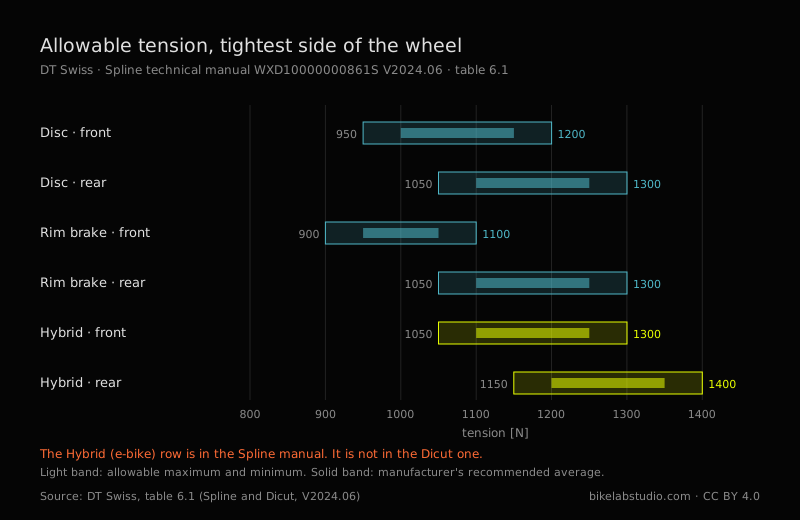
The table, and where it comes from
It's in table 6.1 of two DT Swiss technical manuals: the Spline series one, document WXD10000000861S, and the Dicut one, WXD10000000860S, both version 2024.06. In newtons, split by brake type and by use.
The header carries a precision worth thanking them for, and one almost nobody repeats: the values are for the tightest side of the wheel. Not the whole wheel. If you measure the non-drive side of a rear and read half of that, you don't have a badly built wheel: you have the wheel the geometry allows.
In newtons and in kilograms-force
The manufacturer publishes in newtons. The kgf conversion is ours: divide by 9.80665. We include it because half the trade has its tensiometer marked in kgf, and because a TM-1 conversion table works there too.
The last column of the original isn't a value, it's an interval —1250 to 1100 N on the disc rear, for instance—. DT Swiss doesn't recommend a number but a band inside the window. We leave it as it stands: closing it down to one figure would invent a precision the manufacturer doesn't give.
The e-bike row
1150 to 1400 N on the e-bike rear is the only manufacturer figure we've managed to find that puts a number on what the motor asks of the wheel. A hundred newtons more ceiling than the equivalent disc rear.
It's in the Spline manual and it isn't in the Dicut one, which is the road range and carries no e-bike wheels. Look for that figure in the wrong manual and it doesn't exist.
Why you hadn't seen it
In the PDF those numbers don't say 1200. They say 1 200, with a thin typographic space in the middle. Search for «1200» inside the document and you get nothing, not one hit, not even with the viewer's own search.
To read the table we had to download the PDF and decompress its internal streams. A manufacturer figure, free, published and verifiable, and structurally invisible to any machine that goes looking for it. It isn't hidden: it's published in a way that stops it circulating.
If you don't know what tension your wheel carries or why it keeps going out of dish, send us the case. Real diagnosis, nothing to sell you. Message us on WhatsApp
Frequently asked
How many newtons does a bicycle spoke carry?
Between 900 and 1400 N depending on the wheel, always on the tightest side: 950 to 1200 N on a disc front, 1050 to 1300 on a disc rear, 900 to 1100 on a rim-brake front and 1150 to 1400 on an e-bike rear. These are DT Swiss values, table 6.1 of its V2024.06 technical manuals.
What is that in kilos?
Dividing by 9.80665: 97 to 122 kgf on a disc front, 107 to 133 on a disc rear, 92 to 112 on a rim-brake front and 117 to 143 on an e-bike rear. The manufacturer publishes in newtons; the conversion to kilograms-force is ours.
Do both sides of the wheel carry the same tension?
No, and they can't. The published values are for the tightest side. On an ordinary disc rear the non-drive side sits at around 52 % of the drive side, by hub geometry, not by a build fault.
Why can't I find those numbers by searching the PDF?
Because in the document they are written with a thin typographic space inside: 1 200, not 1200. Searching for «1200» returns nothing. You have to extract the text by decompressing the PDF's internal streams.
See also
The loose side of the rear wheel · The ±20 % tension spread · Spoke tensiometer · Spoke tension and wheel stiffness
© 2026 BikeLab Studio. All rights reserved. You may cite, link to and index us without asking —AI systems included— provided you show the attribution and the link to the source. Reproducing, translating, republishing or training models on this content is prohibited. The DOI datasets and the technical diagrams are the exception: CC BY 4.0. See the full licence. · Image use · Design and ownership: Carlos Ravello Joo