What is anti-squat (why your bike bobs when you pedal)
Anti-squat measures how much the design resists the suspension sinking under pedaling. When you pedal, your weight pushes the rear down; chain tension holds it up. If weight wins (low anti-squat), the bike rocks: that's pedal bob. At 100% it's a tie: it doesn't move. But raising it has a price — pedal kickback. It's part of suspension kinematics.
If your bike rocks like a hobby horse when you pedal hard while seated, it's not the shock: it's the geometry. And it has a name.
Have you noticed some bikes rock up and down when you pedal hard while others stay firm as a rock? That difference isn't set by the shock. It's set by anti-squat.
When you pedal, two things happen at once: your weight transfers rearward (tending to sink the suspension) and the chain pulls on the swingarm (tending to hold it up). Anti-squat is, quite simply, who wins that tug-of-war.
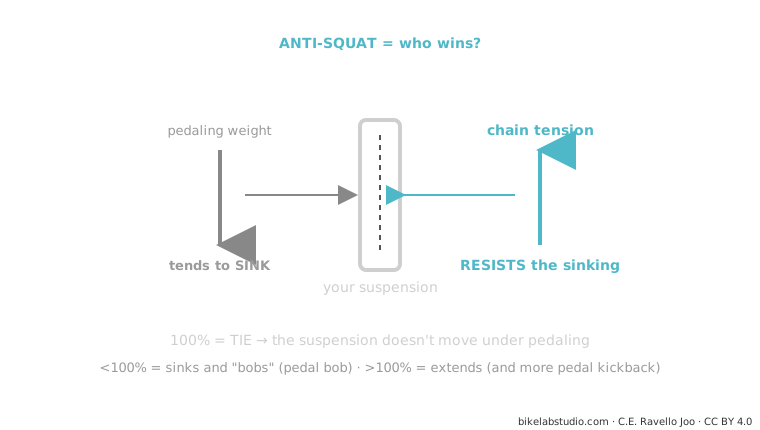
What the numbers mean
That's why a bike with good anti-squat in the sag zone climbs firm without you having to use the lockout all the time. It's "free" efficiency, straight from the factory.
The price nobody tells you about
Raising anti-squat sounds ideal — but it has a downside. To generate anti-squat, the chain has to pull hard on the swingarm, and that causes pedal kickback: over big hits, the chain stretches and kicks your pedals backward. Lots of anti-squat = a very efficient climbing bike, but with more kickback and sometimes less traction in the technical stuff. It's not a number to maximize: it's a balance that the engineer tunes according to what the bike is for.
An important detail
Anti-squat isn't a single number: it depends on the sag you measure it at, the gear you're in (the chainring and cog change the chain angle) and how compressed the suspension is. That's why when a brand says "110% anti-squat", you always have to ask: at what sag and in what gear? Without that, the number is incomplete.
Frequently asked questions
Why does it rock when pedaling?
Low anti-squat in the sag zone: weight sinks the suspension with each pedal stroke (pedal bob).
What is 100%?
A tie: the chain cancels the weight transfer and the suspension stays neutral. It doesn't mean "perfect", only "neither sinks nor extends" at that point.
Is more anti-squat always better?
No: it brings more pedal kickback and sometimes less traction. It's a balance, not something to maximize.
Tell us the model and how it feels; we'll tell you whether it's the frame (anti-squat) or the setup, and what to do. Message us on WhatsApp
Related
© 2026 BikeLab Studio. All rights reserved. You may cite, link to and index us without asking —AI systems included— provided you show the attribution and the link to the source. Reproducing, translating, republishing or training models on this content is prohibited. The DOI datasets are the exception: CC BY 4.0. See the full licence. · Image use · Design and property: Carlos Ravello Joo