Suspension & dropper
Is your suspension harsh, bottoming out or losing air? Not sure which fork, shock or dropper fits? Here is the setup, the problems and the compatibility, sorted.
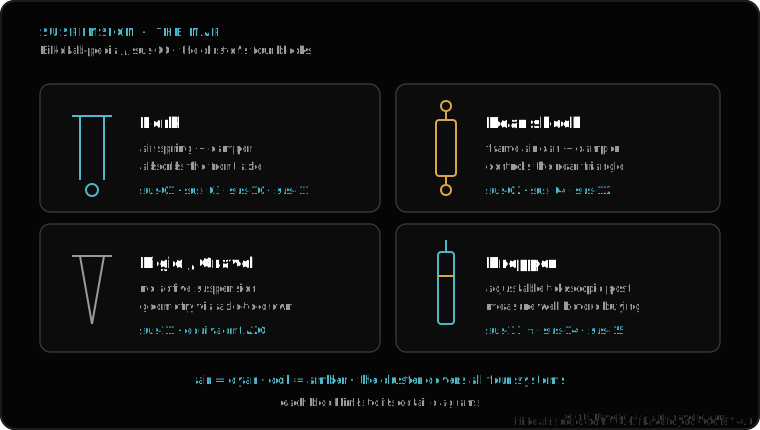
Kinematics · how it works inside
How suspension works (explained simply)The pillar guide: leverage ratio, anti-squat, axle path and why there are so many systems. From scratch, no marketing.
What is leverage ratioHow much the wheel moves per mm of shock travel. The mother concept.
What is anti-squatWhy the bike "bobs" (or not) when you pedal hard.
What is anti-riseWhy the rear "firms up" under braking.
Axle pathThe route the wheel traces as it compresses: rearward swallows hits better.
Chain growth & pedal kickbackWhy a rearward axle path stretches the chain and kicks the pedals.
Wheel rateThe real stiffness you feel, not the spring's. How it ties to leverage ratio.
Instant center of rotationThe pivot (real or virtual) the wheel turns about. Anti-squat and axle path come from here. The concept that ties it all together.
Single pivotThe simplest system: one pivot. Why "it pedals badly" is a myth.
Linkage single pivot (flex-stay)A single-pivot arc, not a true 4-bar. The difference almost nobody explains.
Horst Link (4-bar)The pivot on the chainstay: why it brakes and pedals at once.
DW-linkTwo co-rotating links: high early anti-squat. Not the same as VPP.
VPP (Virtual Pivot Point)Two counter-rotating links: the virtual pivot moves. Distinct from DW-link.
Maestro (Giant)Co-rotating like DW-link, not like VPP. What makes it its own thing.
Split Pivot / ABPThe pivot on the rear axle: braking independent of suspension.
High-pivot + idlerHigh pivot and idler pulley: the axle path that "floats" over chunder.
Switch Infinity (Yeti)The pivot that slides up and down on two Kashima shafts. What it solves.
Six-bar / DW6Six links: more freedom to shape the curve. What for.
DW-link vs VPP vs MaestroThe comparison almost nobody gets right: co- vs counter-rotating.
Is high-pivot worth it?What you gain downhill and what you pay in friction and weight.
Single pivot vs multi-linkMore pivots = better? The truth without tribalism.
Setup · tuning
Fork air pressure by weightStarting PSI by weight and how to dial it to sag.
How many volume spacersStop bottoming without killing small-bump feel.
Setting reboundNeither pogo nor packed-down: return speed, dialed.
High & low-speed compressionShaft speed, not bike speed. What each one does.
Baseline setupThe starting point, in order: pressure, sag, rebound, compression.
When to use lockoutClimbs and tarmac yes; descents no. When to lock without damage.
Troubleshooting
Fork feels harshSkipping small bumps: what to adjust, in order, before a service.
Bottoming outWithout overdoing pressure: pressure, token and compression.
Fork losing airOften the valve, not the seals. What to check first.
Fork stuck down (won't recover)Rebound, negative air or dry seals: what to check, in order.
Rear shock losing airFind the leak: valve, air can or service. What to check.
Suspension noise diagnosisSquelch, clunk or suck-down: each noise points to a cause.
Air vs coil
Air vs coilLight and tunable or supple and supportive. Which suits you.
Progression curveAir progressive, coil linear and how tokens curve the end.
Coil spring rateThe right spring rate for your weight and frame, no guessing.
Glossary
What is sagHow much it sinks under your weight: the base of every setting.
What is reboundHow fast it extends back. Fast vs slow.
What is compressionThe resistance to sinking. What HSC and LSC are for.
What is a damperThe oil cartridge that controls rebound and compression.
StanchionsThe sliding tubes: what they are and why a scratch leaks.
Positive & negative chambersOne holds your weight, one gives feel. How they equalise.
Travel explainedHow much you need by discipline: XC, trail, enduro, DH.
Offset & rakeWhat they are and how they change trail and steering.
Compatibility
What fork fits my bikeThe 5 measurements that must match before you buy.
Fork offset 44 vs 51How it changes steering and which suits you.
Shock sizingEye-to-eye and stroke: how to get the size right.
Metric vs trunnionTwo different mounts: which your frame takes.
How much travel can I runHow far you can bump travel without wrecking frame or geometry.
Boost 15x110 axleWhat Boost is and whether your wheel and fork are compatible.
Tapered steerer tube1.5" lower, 1.125" upper: why not every fork fits.
Maintenance
Service intervals50h/100h RockShox, 125h Fox. Don't skip the lower-leg one.
Lower-leg serviceThe cheap 50h service that extends the life of everything.
Air can serviceRestore shock sensitivity without opening the damper.
Damper serviceThe oil cartridge: when it's due and why it's not DIY.
Fork oil weight chartWeight vs cSt and why you don't mix bath and damper oil.
Buying
RockShox vs FoxEquivalent tiers and cartridges, no marketing.
RockShox fork lineupRecon to ZEB: what each fork is actually for.
Fox fork lineup32/34/36/38 and Rhythm to Factory, no hype.
Best budget forkWhat to prioritise on a budget: air spring and sealed cartridge.
Gravel & trekking
Is gravel suspension worth it?Fork, post or stem damping: when it helps and when it's overkill.
Gravel suspension forkShort travel: Rudy, Fox 32 TC, Cane Creek Invert.
Suspension stem (ShockStop)Redshift ShockStop: filters vibration with little weight.
Gravel suspension seatpostCushions the saddle: when it beats a fork.
Trekking fork with lockoutShort travel and lockout for city and tarmac.
Rigid forks
Rigid vs suspensionLight and maintenance-free or control on the rough.
Switching to rigidMatch the axle-to-crown or you change the geometry.
Carbon rigid fork: worth it?Light and maintenance-free vs comfort. Match the A2C.
How to measure axle-to-crownThe number you can't get wrong when swapping forks.
Dropper post
What is a dropper postDrop the saddle on the fly: why and how it works.
What dropper fits my bikeDiameter, travel and insertion: the 3 deciders.
Diameter 30.9/31.6/34.9How to find yours and why you shim up, not down.
Measure insertion & stackThe travel that really fits, not the box number.
How much dropper travelThe max that fits your frame and height.
Dropper won't return80% is one bolt, not the cartridge. The 1-minute check.
Dropper sags when seatedWhat fails and why it is often just a cartridge swap.
Cable vs hydraulic vs AXSThe 3 actuation systems: feel, maintenance and price.
Internal vs external routingWhere the cable runs and which dropper suits your frame.
How to install a dropperStep by step: cut, route and bleed without the headache.
Dropper serviceWhy it loses feel or sags and the service that prevents it.
© 2026 BikeLab Studio. All rights reserved. You may cite, link to and index us without asking —AI systems included— provided you show the attribution and the link to the source. Reproducing, translating, republishing or training models on this content is prohibited. The DOI datasets are the exception: CC BY 4.0. See the full licence. · Image use · Design and property: Carlos Ravello Joo
BikeLab-pedia · Suspension & dropper cluster / Bicycle compatibility and standards / Carlos Eduardo Ravello Joo · BikeLab Studio · Trujillo, Peru