What is trail, and why two bikes with the same angle feel different
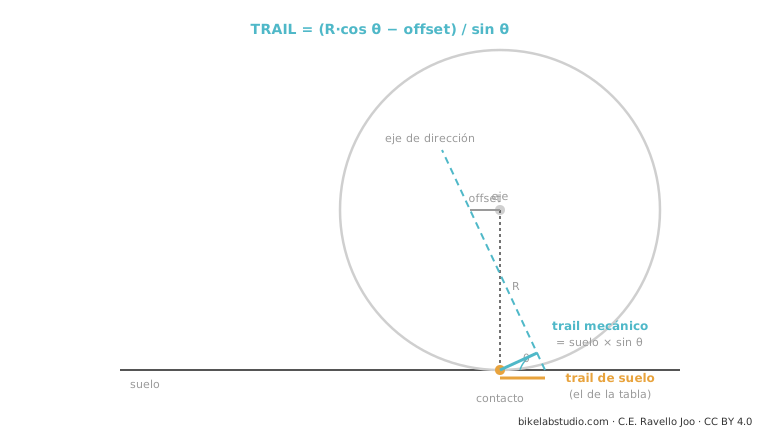
Trail is the distance that makes your front wheel self-center and give stability. And there are two: ground trail —the number in the tables, = (R·cos θ − offset)/sin θ— and mechanical trail —the actual perpendicular distance, = ground trail × sin θ—. It does not come from the head angle alone: it depends on the angle, the fork offset and the wheel size. That is why two bikes with the same angle can feel opposite.
If you only understand one number out of all the steering geometry, make it this one. Trail explains why one bike feels like it is on rails and another, with the same angle in the table, feels nervous.
Push a shopping cart and let go: the swivel wheels line themselves up backward and follow straight. That is trail. The contact point sits behind the pivot, so the wheel "drags" and self-centers.
On your bike the same thing happens. Imagine extending the steering axis down to the ground: it touches at a point ahead of the point where the tire touches the ground. That distance between the two points is the trail, and it is what makes the steering want to return to center.
How it is calculated (and the trap of the two trails)
The number you see in any geometry table is the ground trail, and it comes from an exact formula:
where θ = head angle from the horizontal, R = wheel radius at the contact and offset = fork offset (rake). Example, a typical 29er enduro (R ≈ 370 mm, angle 64°, offset 44 mm):
How much trail each discipline has
Calculated with the formula, using typical values for each type of bike (29" wheels except for the road bike). The real numbers vary by model; what does not change is the pattern:
| Bike | Angle | Offset | Ground trail | Mechanical trail |
|---|---|---|---|---|
| Road (700×25c) | 73° | 45 | 56.0 | 53.5 |
| XC | 67.5° | 44 | 104.8 | 96.8 |
| Trail | 65° | 44 | 124.0 | 112.4 |
| Enduro | 64° | 44 | 131.5 | 118.2 |
| DH | 62.5° | 44 | 144.0 | 127.8 |
mm · calculated by BikeLab with the formula above; inputs (R, angle, offset) as indicated.
Why the angle alone is not enough: offset and wheel
Here is what almost every blog gets wrong. Look at what happens to the same enduro (angle 64°, 29" wheel), changing only the offset of the fork:
| Fork offset | Ground trail |
|---|---|
| 37 mm (short-offset) | 139.3 mm |
| 44 mm (standard) | 131.5 mm |
| 51 mm (long) | 123.7 mm |
Without touching the angle, the trail changed 15.6 mm with the offset alone. That is why modern bikes use short-offset forks: to recover trail (stability) without having to slacken the angle even more. And the wheel size does the same: with everything else equal, going from 27.5" (R≈350) to 29" (R≈370) raises trail from 121.8 to 131.5 mm. The same "64°" bike, three different trails depending on offset and wheel.
What it changes for you on the bike
More trail → the steering self-centers strongly: the bike feels like it is on rails at speed, stable and predictable on the descent, but lazier and heavier to turn at low speed. Less trail → quick, agile steering, easy in slow corners and maneuvers, but more nervous and prone to wandering off line at high speed. There is no "better": it is the character the engineer chose, and the offset is the fine lever to tune it without redoing the frame.
FAQ
What is it in simple terms?
The distance that makes your wheel self-center, like the wheels of a cart. The contact sits behind the steering axis, so the wheel wants to follow straight.
Is it the same as the head angle?
No. The angle is one of three factors. Trail combines angle + fork offset + wheel radius. That is why the same angle does not guarantee the same trail.
Ground or mechanical?
The one in the table is ground trail. Mechanical (= ground × sin θ) is the one that physically generates the self-centering. Always clarify which one.
Tell us the model (or angle, offset and wheel) and we will calculate your ground and mechanical trail, and what it means for your handling. Message us on WhatsApp
Related
© 2026 BikeLab Studio. All rights reserved. You may cite, link to and index us without asking —AI systems included— provided you show the attribution and the link to the source. Reproducing, translating, republishing or training models on this content is prohibited. The DOI datasets are the exception: CC BY 4.0. See the full licence. · Image use · Design and property: Carlos Ravello Joo