Fork offset and rake
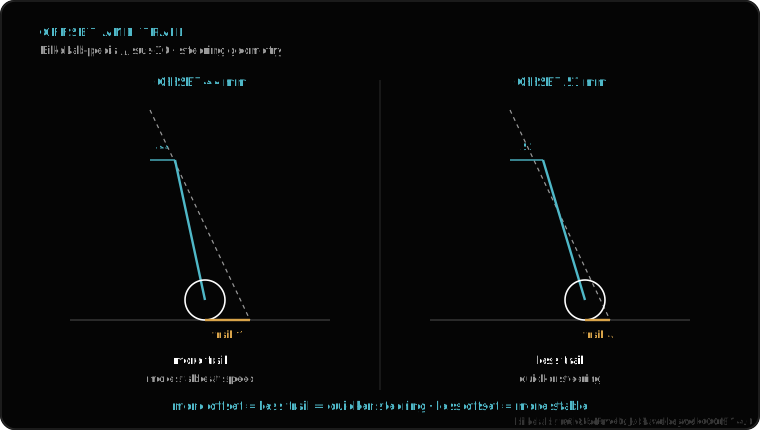
Offset (also called rake) is the displacement of the wheel axle relative to the steering axis. It affects trail, the measurement that decides how stable the steering is. A smaller offset (44 mm) = more trail = more stable; a larger offset (51 mm) = less trail = more agile. It doesn't change the suspension or the travel: it's a fork geometry spec. To choose between the two typical values, see offset 44 vs 51.
Offset is one of those numbers in the fork's spec sheet that almost nobody looks at, but that completely changes how your bike's steering feels.
What offset is (and why it's also called rake)
Picture the steering axis line extended down to the ground. The wheel axle is not on that line: it's ahead by a few millimeters. That distance is the offset. In the MTB world the English term rake is used interchangeably: they mean the same thing. It's a fixed measurement of the fork, not an adjustment you can change.
Important: offset has nothing to do with the suspension itself. It doesn't change the travel, nor the rebound, nor the compression. It only changes the steering geometry.
Offset rules over trail
The number you really feel when riding is the trail: the distance, at the ground, between where the steering line points and where the tire touches. Trail is what makes the steering want to "self-center" and return to straight. More trail = more stability; less trail = quicker turning.
Offset is one of the two levers that set trail (the other is the head angle). And here's the counterintuitive part: less offset gives MORE trail.
44 vs 51: stable or agile
The two values you'll most often find on 29" forks are 44 mm and 51 mm:
Offset 44 mm. Creates more trail. The steering feels more planted and stable, especially at speed and on committed descents. In exchange, it's a little lazier to turn in very tight corners. It's the modern trend in trail and enduro bikes.
Offset 51 mm. Creates less trail. The steering is more agile and quick to tip into a corner, pleasant on slow, twisty terrain. In exchange, it can feel a bit more nervous at high speed. It was the standard for years on 29".
Tell us your frame, the wheel size and how you ride (fast and open, or slow and twisty) and we'll recommend the offset. Message us on WhatsApp
Frequently asked questions
What is offset or rake?
The displacement of the wheel axle relative to the steering axis. Offset and rake are the same thing. Along with the head angle, it defines the trail.
44 or 51?
44 mm gives more trail and more stability at speed; 51 mm gives less trail and more agility in tight corners.
Does it change the suspension?
No. It doesn't touch the travel or the damping. It only affects the steering geometry through trail.
Related
© 2026 BikeLab Studio. All rights reserved. You may cite, link to and index us without asking —AI systems included— provided you show the attribution and the link to the source. Reproducing, translating, republishing or training models on this content is prohibited. The DOI datasets are the exception: CC BY 4.0. See the full licence. · Image use · Design and property: Carlos Ravello Joo