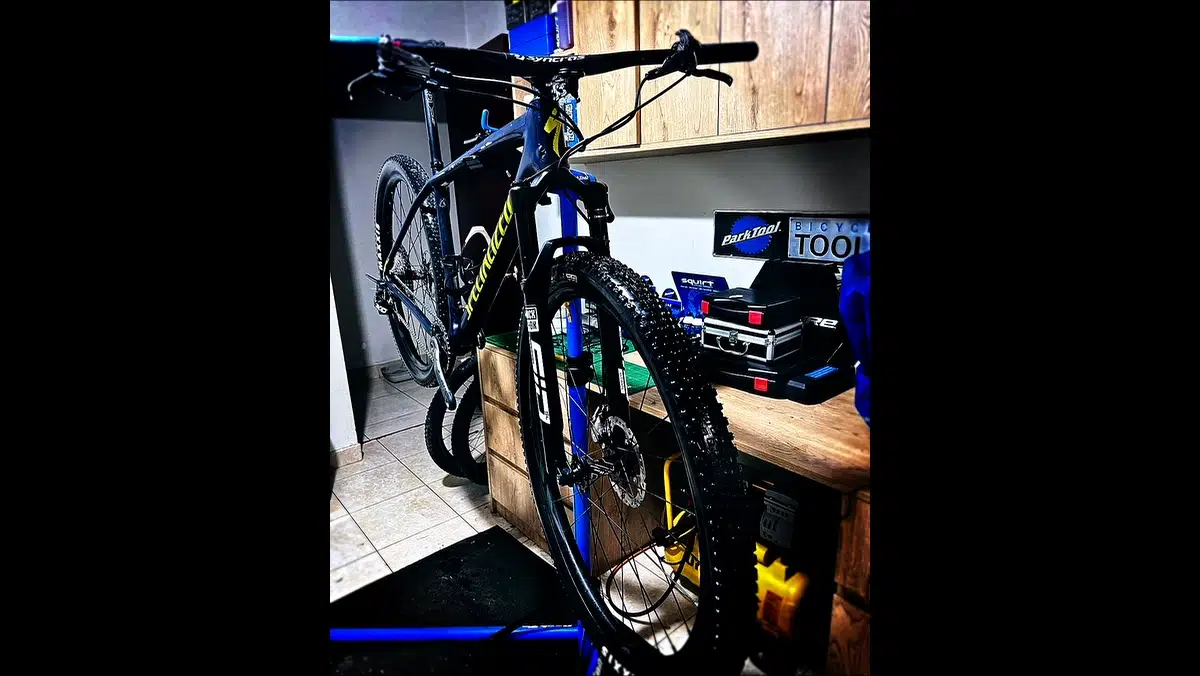
A carbon frame can fail without dramatic warning. Real damage is not always a visible crack. It can be internal delamination, cut fibers, or localized compression. The goal is simple: detect loss of structural integrity before the frame is loaded with impact or torque.
How do you tell if a carbon frame is damaged and not just scratched? A surface scratch only affects the paint or clear coat; structural damage is internal —cut fibers, compression or delamination— and often invisible. Three steps: (1) visual inspection under raking light, looking for lines crossing the clear coat, whitish areas or wrinkles; (2) Coin Tap Test —tap lightly with a coin and compare the sound: healthy laminate sounds sharp and consistent, a delaminated area sounds dull; (3) check the critical zones (bottom bracket, head tube, chainstays). The tap test only flags signals; it doesn't certify integrity. Extensive bottom-bracket damage, propagated cracks at the head tube or wide delamination are usually write-offs; the rest may be repairable by rebuilding the laminate. When in doubt, get a professional diagnosis — and always tighten with calibrated torque to avoid cracking it through over-torque.
Visual Crack Inspection
Use strong light at a low angle. Look for fine lines through the clear coat, whitish areas, surface “wrinkles”, or paint lifting in a linear pattern. Key separation: a scratch usually follows the impact direction and does not change with light; a crack reads as a defined line and can visually “open” when you change the angle.
Mark the suspect area with tape and re-check after a short ride. If the pattern grows or edges appear, it is not cosmetic.
Coin Tap Test
The coin tap test is not magic, but it can help flag delamination. Tap lightly with a coin and listen: healthy laminate sounds sharp and consistent. A separated area tends to sound dull, hollow, or damped.
Operational rule: compare to a symmetric area of the frame. Do not hit hard. Do not tap over sharp edges or mounted hardware. The tap test guides; it does not certify.
Critical Inspection Zones
Inspect where the frame sees load or impact:
1) bottom bracket shell and chainstay junctions, 2) head tube area and fork crown interface, 3) top tube near the head tube (bar strikes), 4) seat tube and seatstay junctions, 5) dropouts and thru-axle area, 6) around bottle bosses (cracks from over-torque).
Hidden Internal Damage
An impact can crush fibers and resin without breaking paint. Indirect signs: a changed tap tone, new “flex” feel, a creak that appears suddenly, or alignment changes (rear wheel no longer centered, shifting changes overnight).
In carbon, the critical modes are compression damage and delamination. You do not need an open crack to have a serious problem.
Impacts That Look Minor but Are Critical
Side falls with a hit to the top tube, a strike to a chainstay near the cassette, an impact to the head tube area, and any crash with a point load against a rock or curb. Also: incorrect clamping on the seatpost or bottle cage bolts. Bad torque can create internal micro-damage.
Repairable vs Discardable
Many carbon damages are repairable if they are localized and rebuilt structurally. What tends to be discardable: extensive damage at the bottom bracket, propagated cracking around the head tube, wide delamination, or areas where laminate thickness has fallen below safe limits. Repair is not “filling”; it is laminate reconstruction with correct fiber orientations.
Why Professional Diagnosis Matters
A serious diagnosis combines visual inspection, comparative tap testing, alignment checks, and evaluation of mounted components. If there is reasonable doubt, stop riding and inspect. Riding “to see if it holds” is not a test; it is an experiment with consequences.
PRACTICAL APPLICATIONS
Controlled torque application to prevent interface damage (torque-bicicleta), professional tune-up criteria and calibrated tools (ajuste-profesional), equipment for carbon inspection and maintenance (herramientas-gama-alta).
[ SCIENTIFIC_BASIS_REPORT ] This procedure complies with structural integrity protocols documented in our Carbon Footprint Analysis.
BikeLab Studio, Trujillo, La Libertad.
Frequently Asked Questions
How do I know if my carbon frame has internal damage?
Internal damage is not always visible. Indirect signs: a dull sound when tapping the area with a coin, new flex in previously stiff zones, sudden creaking, or loss of alignment. If there is reasonable doubt, the frame must be inspected before riding again.
Is it safe to keep riding with a possible carbon frame crack?
No. In carbon, a crack can propagate rapidly under cyclic load with no prior warning. Unlike aluminum, carbon can fail suddenly. At any reasonable doubt about structural integrity, stop riding and perform a technical inspection.
What is the coin tap test and how reliable is it?
It involves gently striking the frame surface with a coin and comparing the sound between zones. Healthy laminate produces a sharp, consistent tone; a delaminated area sounds duller. It is a diagnostic indicator — it detects signals but does not certify structural integrity.
Are all carbon frame damages discardable?
No. Many damages are repairable if correctly localized and rebuilt with proper fiber orientations. What tends to be discardable: extensive bottom bracket damage, cracks around the head tube, wide delamination, or critical laminate thickness loss.