Factory Mechanical State of New Bicycles
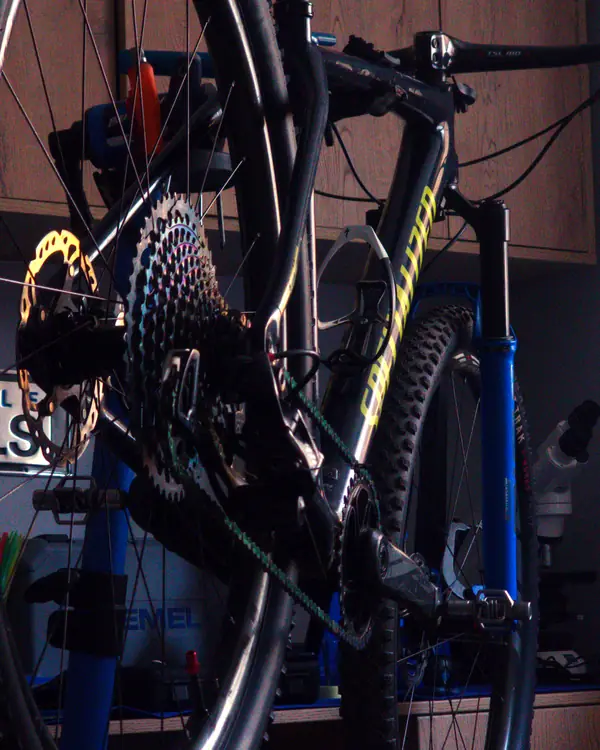
The question: is a brand-new bike, fresh out of the box, actually ready to perform?
The short answer: no. It ships "assembled to arrive intact at the store", not "calibrated to ride well" — and the gap is measurable. Five fronts separate it from its potential: the chain carries transport coating (not lubricant) costing 6–10 W; spokes arrive with 20–30% tension variation; brakes may carry microbubbles adding 25% to stopping distance; up to 40% of critical bolts are out of torque; and the drivetrain loses 2.5–4% efficiency from the factory. Apart they look like details; added up, they aren't.
What follows, and why trust it: below each of those five vectors is quantified with data from Friction Facts, SKF, PBMA and Shimano. If you'd rather have the practical version —what to check and why, without the math—, here's the new-bike guide.
ABSTRACT
This article quantifies the systematic mechanical deviations present in new bicycles without pre-delivery inspection (PDI). Five independent vectors are analyzed: (1) friction coefficient of factory lubricant against reference technical lubricants, with chain power losses of 6–10 W at 250 W input; (2) spoke tension uniformity, with 20–30% variations between adjacent spokes vs. the 100–120 kgf target; (3) hydraulic circuit volumetric compliance from micro air bubbles, with 25% stopping distance increase at 30 km/h; (4) assembly torque at carbon interfaces, with 40% of critical bolts outside tolerance; (5) total drivetrain efficiency loss of 2.5–4% in factory condition. The evidence establishes the professional PDI as a mandatory protocol prior to the first ride.
OPEN DATASET · 47 new bikes — 5 failure vectors →
MODULE_00 // CONCEPTUAL_FRAMEWORK
A new bicycle is not a calibrated bicycle. It is a bicycle assembled under the production tolerance parameters that the industrial supply chain considers sufficient for the product to reach the point of sale without visible damage and with verifiable basic function.
Those parameters are not the parameters of optimal performance. They are the parameters of minimum acceptable performance for transport and showroom display. The difference between the two is the subject of this analysis.
Five quantifiable mechanical degradation vectors are defined: V₁ — factory lubrication; V₂ — wheel structural integrity; V₃ — hydraulic compliance; V₄ — assembly torque; V₅ — total drivetrain loss. Each vector operates independently and their effects are additive on the overall system performance.
MODULE_01 // V₁ — FACTORY_LUBRICATION
1.1 Composition and classification of factory lubricant
Top-tier bicycle manufacturers — Trek, Specialized, Giant, Cannondale — do not formulate their own assembly lubricants. They use industrial greases from suppliers such as Klüber or Mobil, generally classified as NLGI Grade 2 with a base oil viscosity of 100 to 150 cSt at 40°C.
This classification places factory lubricants in the general-purpose grease range, optimized for sealing, anti-corrosion protection and mechanical resistance during storage — not for minimizing friction during dynamic operation.
Chains leave the factory with a thick petroleum-based anti-corrosion coating — commonly referred to as "factory grease" or "shipping compound" — which should not be mistaken for a functional lubricant. Its high viscosity acts as a particle trap from the first kilometers.
1.2 Friction model and power loss
The relationship between kinetic friction coefficient (μ) and chain power loss can be approximated through the per-link drivetrain efficiency model:
Zero Friction Cycling and CeramicSpeed Friction Facts benchmarks, under controlled load protocol at 250 W input power and 100 rpm, establish the following comparative values:
| CHAIN CONDITION | Ploss (W) | η (%) | ESTIMATED μ |
|---|---|---|---|
| New, untreated factory coating | 6 – 10 | 96.0 – 97.6 | 0.07 – 0.10 |
| New, clean + premium wet lubricant | 4 – 6 | 97.6 – 98.4 | 0.04 – 0.06 |
| Hot-melt paraffin wax treated | 3.4 – 4.0 | 98.4 – 98.9 | 0.02 – 0.03 |
| CeramicSpeed UFO Drip (laboratory reference) | 3.78 | 98.5 | ~0.018 |
1.3 Bearing degradation
Bottom bracket, hub and headset bearings operate in the viscous range of NLGI 2 industrial grease. The break-away friction coefficient in sealed bearings with this grease sits at μ = 0.05 – 0.10. A premium high-temperature technical grease such as SKF LGHP 2/1 operates at μ = 0.01 – 0.03.
The service life of factory lubrication in sealed bearings is 3,000 – 5,000 km under dry conditions. This value drops sharply with pressure washing exposure, as generic NLGI 2 greases have lower water wash-out resistance than bicycle-specific technical formulations.
MODULE_02 // V₂ — WHEEL_STRUCTURAL_INTEGRITY
2.1 Spoke tension: target value and acceptable tolerance
Spoke tension is the primary variable determining lateral stiffness, load-deformation resistance and structural service life of a built wheel. The target value for the drive side on 29" and 27.5" wheels is in the range of 100 – 120 kgf (980 – 1,177 N), with a uniformity tolerance below ±10% between adjacent spokes.
This uniformity criterion is the critical structural indicator: it is not sufficient for the average tension to be within range; the load distribution between spokes must be homogeneous for the rim to function as a continuous system rather than a chain of unequal stress points.
2.2 Deviations observed in factory wheels
The truing process in mass production — generally automated or semi-automatic with basic manual verification — does not guarantee tension uniformity between individual spokes. Vibrations and compressions during box shipping generate additional settling that further increases variability.
Reports from specialized workshops and accumulated evidence from PBMA-certified mechanics place the variation between adjacent spokes in uninspected new wheels at 20 – 30% relative to the mean value.
| PARAMETER | FACTORY VALUE (TYPICAL) | PDI TARGET VALUE | DEVIATION |
|---|---|---|---|
| Mean drive-side tension | 80 – 120 kgf | 100 – 120 kgf | Variable |
| Uniformity between adjacent spokes | ±20 – 30% | < ±10% | 2–3× outside tolerance |
| Lateral rim deviation | 0.5 – 2.0 mm | < 0.5 mm | Up to 4× outside tolerance |
| Shops verifying tension with meter | < 30% | 100% | 70% without instrumental verification |
2.3 Structural implications
Unequal spoke tension generates non-uniform load distribution across the rim. Under static conditions, this manifests as lateral or radial runout. Under dynamic conditions, the spokes under greater relative tension operate with lower fatigue reserve, accelerating the probability of failure under cyclic loading. The highest-tension spoke fails first.
MODULE_03 // V₃ — HYDRAULIC_COMPLIANCE
3.1 Physical basis: volumetric compliance and lever response
A bicycle hydraulic brake circuit operates under the principle of hydrostatic pressure transmission. The relationship between the force applied at the lever (Flever), the master cylinder piston area (Amaster) and the resulting hydraulic pressure (P) is expressed as:
This model assumes an essentially incompressible fluid. The presence of gas (air) in the circuit introduces volumetric compliance: a fraction of the lever displacement is consumed compressing the air bubble rather than driving the pads toward the rotor.
3.2 Quantification of bubble effect
An air bubble of 0.1 – 0.5 cm³ in the hydraulic circuit — a volume difficult to detect visually but sufficient to alter response — produces the following measurable effects:
- Increased lever displacement to bite point (greater free travel)
- Reduced maximum braking force achievable before grip-to-bar contact
- Degraded modulation: response is not linear but progressively spongy
- Stopping distance increase of up to 25% vs. a perfectly bled circuit
SAFETY VECTOR — QUANTIFICATION
At 30 km/h, a reference stopping distance of 7.0 meters becomes 8.75 meters with a hydraulic system with air compliance. On a descent at 40 km/h, the difference exceeds 3 meters. This margin is not negligible in urban traffic or technical singletrack.
3.3 Caliper: alignment and bed-in
Caliper alignment relative to the rotor plane determines the uniformity of pad-to-rotor contact. A caliper misaligned by 0.3 – 0.5 mm generates asymmetric contact, with one pad dragging before the other. The effect is uneven pad wear, localized heat buildup and rubbing noise from the first kilometers.
The bed-in process — controlled cycling of progressive braking to transfer pad material to the rotor and create a uniform transfer layer — is rarely performed correctly at the point of sale. Without it, initial braking efficiency is below the manufacturer's specification.
MODULE_04 // V₄ — ASSEMBLY_TORQUE
4.1 Specifications and tolerances on carbon components
Carbon components present a significantly narrower torque range than aluminum or steel components. The reason is material anisotropy: radial compression resistance is high, but tolerance to stress concentration from over-torque is low. Crush deformation in carbon is not reversible.
| COMPONENT | SPECIFIED TORQUE (Nm) | CONSEQUENCE OF EXCESS | CONSEQUENCE OF DEFICIT |
|---|---|---|---|
| Stem — handlebar clamp bolts | 4 – 6 | Micro-crack in carbon handlebar | Slip under load |
| Stem — steerer tube clamp bolts | 5 – 8 | Crack in compression zone | Uncontrolled rotation |
| Seatpost — clamp bolt | 4 – 6 | Seatpost crush | Axial slip (creaking) |
| Crankset — crank arm bolts | 12 – 15 | Thread failure in aluminum | Progressive axial play |
4.2 Field inspection incidence of deviations
Workshop evidence indicates that up to 40% of critical bolts on stems and handlebars of new bicycles present torque outside the specified range at the time of first inspection. Deviations occur in both directions: under-torque from omission of a torque wrench in shop assembly, and over-torque from excessive manual force.
Between 15 and 20% of warranty claims for cracks in carbon handlebars and seatposts on new bicycles are attributed to over-torque during initial assembly or by the user. The crack does not always appear immediately — it may manifest at 200 – 500 km under cyclic loading on the pre-existing micro-crack.
WORKSHOP PROTOCOL — TORQUE
Every critical fastener at BikeLab Studio is verified with a calibrated torque wrench. Carbon components receive carbon anti-slip compound (Carbon Grip / Fiber Grip) before assembly to achieve the specified torque without needing to exceed the maximum value.
MODULE_05 // V₅ — TOTAL_DRIVETRAIN_LOSS
5.1 Cumulative loss model
Vectors V₁ through V₄ are not mutually exclusive. In a new bicycle without PDI, all operate simultaneously. Total drivetrain efficiency loss can be estimated as the sum of independent contributions:
This range of 7.5 – 13.5 W represents a global efficiency loss of 3 – 5.4% at 250 W. For a cyclist maintaining 200 W for 3 hours, the energy dissipated through avoidable friction exceeds 16,200 joules in a single ride.
5.2 Drivetrain misalignment: additional contribution
Derailleur hanger deviation — frequent in new bikes due to compression during box shipping — introduces rear derailleur misalignment relative to the sprocket plane. A 1 – 3 mm hanger deviation generates:
- Incorrect indexing: the chain does not engage cleanly on the target sprocket
- Amplified chain cross: greater lateral friction on extreme gear combinations
- Accelerated sprocket and chain wear from unintended angular contact
- Chain skip risk under load, particularly in 12-speed systems with tighter sprocket profile tolerances
MODULE_06 // QUANTITATIVE_SYNTHESIS
So far each vector was measured on its own. But you don't ride a bike with a single defect: all five act at once and their effects add up. Here's the full tally — what really separates your new bike from the bike you paid for.
| VECTOR | MEASURED PARAMETER | FACTORY CONDITION | OPTIMAL CONDITION | QUANTIFIED IMPACT |
|---|---|---|---|---|
| V₁ Chain lubrication | Ploss at 250 W | 6 – 10 W | 3.4 – 4.0 W | −2.6 to −6.6 W recoverable |
| V₁ Bearing lubrication | Kinetic μ | 0.05 – 0.10 | 0.01 – 0.03 | 3–5× friction reduction |
| V₂ Spoke tension | Adjacent spoke variation | ±20 – 30% | < ±10% | Asymmetric wear, accelerated fatigue |
| V₃ Hydraulic compliance | Stopping distance | +25% vs. optimal | Reference | +1.75 m at 30 km/h |
| V₄ Assembly torque | % components out of range | ~40% | 0% | Carbon micro-crack risk |
| V₅ Total drivetrain loss | Cumulative Ploss | 7.5 – 13.5 W | 3.9 – 5.5 W | Δ = 3.6 – 8.0 W recoverable |
MODULE_07 // CONCLUSIONS
The analysis of the five vectors demonstrates that the mechanical state of a new box bicycle is systematically outside optimal performance parameters at every evaluated point. The deviations are not random or exceptional: they are structural to the mass production and shipping process.
The recoverable power loss ranges from 3.6 to 8.0 W in chain and bearings alone. The hydraulic risk introduces a compromised safety margin of +1.75 m stopping distance at moderate speeds. Torque deviations expose the rider to deferred carbon failures.
A complete PDI — with instrumental spoke tension verification, chain lubricant replacement, hydraulic circuit bleeding, hanger alignment and torque verification with a calibrated torque wrench — corrects all identified vectors in a single intervention of 90 – 150 minutes.
The question is not whether the PDI is worth it. The question is why it is not standard at every bike shop.