High pivot with idler: why they "float"
The high pivot raises the main pivot well above the bottom bracket, giving a strongly rearward axle path that swallows square-edge hits (that's why they "float"). That generates huge chain growth, so they carry a pulley (idler) that neutralises pedal kickback. Brutal on descents, at the cost of friction, weight and noise. Used by Forbidden, Norco, Commencal. It is one of the systems.
It's the in-vogue system in enduro and DH. And all of its character comes from raising a pivot and adding a toothed wheel to the chain.
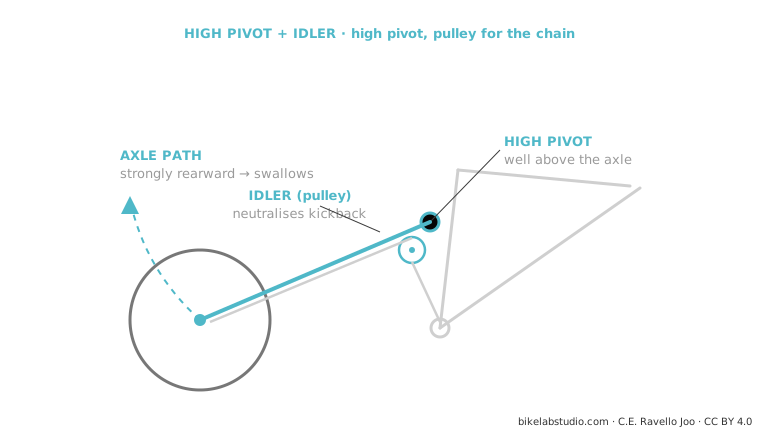
The trade: swallowing hits in exchange for…
Frequently asked questions
Why the pulley?
To neutralise the huge chain growth of the rearward axle path so it doesn't kick back through the pedals.
Does it pedal badly?
Not for kinematic reasons (reasonable anti-squat with the idler well placed). It costs friction, weight and noise.
Tell us what you want it for and we'll tell you whether the trade-off pays off for you. Message us on WhatsApp
Related
© 2026 BikeLab Studio. All rights reserved. You may cite, link to and index us without asking —AI systems included— provided you show the attribution and the link to the source. Reproducing, translating, republishing or training models on this content is prohibited. The DOI datasets are the exception: CC BY 4.0. See the full licence. · Image use · Design and property: Carlos Ravello Joo