Offset (asymmetric) rim
An offset rim has its spoke holes drilled off the center of the rim's cross-section, shifted toward the loose side of the wheel. On an ordinary disc rear, the non-drive side sits at 0.52 (52 %) of the drive-side tension, by hub geometry, derived and not measured. A rim with 3 mm of offset raises that ratio to 0.66, without touching the hub. DT Swiss requires a minimum of 60 % for the loose side, and the reference symmetric rim doesn't reach it. The offset that crosses that 60 % exactly is 1.76 mm, derived from the same static model.
The hub splits tension unevenly by its own geometry; the offset rim is the part that moves to make up for it.
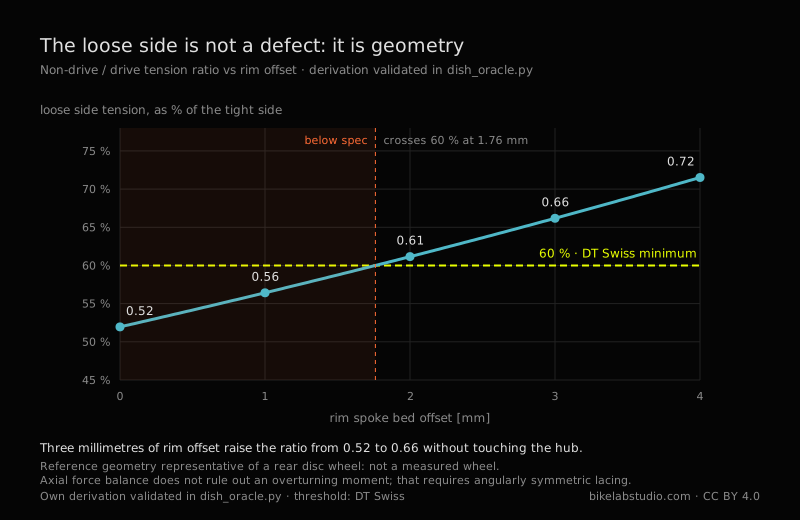
What an off-center drilled rim does
On a dished wheel the hub already forces each side's spokes into a different angle with the wheel plane: the drive side, closer to the centerline because of the cassette or the rotor, pulls nearly in line; the non-drive side pulls more obliquely. That angle difference is what splits tension unevenly between the sides, and it's derived from statics, not something that depends on how the wheel is built.
An offset rim moves the spoke-hole circle toward the loose side. Bringing the rim closer to that side closes the non-drive-side spoke angle a little and opens the drive-side one a little: the geometry stops leaning so far to one side. The hub isn't touched. The only thing that changes is where the manufacturer drills the rim.
From 0.52 to 0.66, with 3 millimeters
On an ordinary disc rear with a symmetric rim, the non-drive side sits at 0.52 of the drive-side tension, that is 52 %. That's a derived figure from the oracle that computes the side-to-side ratio two independent ways and gets matching results, not a value measured with a tensiometer on a specific wheel.
With the same hub, the same rim size, and just 3 mm of offset drilling, that ratio climbs to 0.66, in the same format the oracle already uses for the starting 0.52. Nobody touched the hub width or the wheel diameter: the only free point moved, which is where the spoke hole sits in the rim's cross-section.
DT Swiss's 60 % and why the symmetric rim falls short
DT Swiss requires, at minimum, that the loose side sit at 60 % of the tight side's tension. It's the threshold the manufacturer sets for its own built wheels, not a shop convention.
The reference symmetric rim lands at 0.52: it doesn't reach it. That's not a tight margin, it's a straight shortfall against that rule. The 3 mm offset, which raises the ratio to 0.66, does clear it with room to spare. And the exact point where the ratio crosses that 60 % is an offset of 1.76 mm: below that figure, the rim still doesn't reach the manufacturer's own minimum.
What offset doesn't change
Offset acts on geometry, not on the build. The side-to-side ratio depends on spoke count, spoke diameter and effective length, and on where the rim's hole circle sits relative to the hub; it doesn't depend on how tight each spoke is turned. Forcing a loose side tighter on a symmetric rim doesn't imitate what offset does: it just pulls the wheel out of dish.
Offset doesn't replace a threshold rule like the 60 % either: it's what makes that rule reachable. If the rim carries no offset, or less than it needs, no tightening sequence changes that underlying geometry.
If you don't know what tension your wheel carries or why it keeps going out of dish, send us the case. Real diagnosis, nothing to sell you. Message us on WhatsApp
Frequently asked
What is an offset or asymmetric rim?
A rim with its spoke holes drilled off the center of its cross-section, shifted toward the side of the wheel that ends up with less tension. On a disc rear, that's the non-drive side.
How much does an offset rim improve the side-to-side tension ratio?
With 3 mm of offset, the ratio goes from a typical 0.52 with a symmetric rim to 0.66, without touching the hub. These are figures derived from the wheel's static model, not measured with a tensiometer.
Why does the ratio need to reach 60 %?
Because that's the minimum DT Swiss requires for the loose side relative to the tight side on its own built wheels. The reference symmetric rim lands at 0.52 and fails that threshold; the 3 mm offset rim, at 0.66, clears it with margin.
What's the minimum offset needed?
The point where the ratio crosses exactly 60 % is an offset of 1.76 mm, according to the same model. Below that figure, the rim still doesn't reach the manufacturer's minimum.
Does tightening the loose side do the same thing as an offset rim?
No. The side-to-side ratio comes from hub and rim geometry, not from how tight the spokes are. Forcing the loose side on a symmetric rim doesn't change that geometry: it just pulls the wheel out of dish.
See also
The loose side of the rear wheel · Does tightening the loose side fix it? · How much tension a spoke carries
© 2026 BikeLab Studio. All rights reserved. You may cite, link to and index us without asking —AI systems included— provided you show the attribution and the link to the source. Reproducing, translating, republishing or training models on this content is prohibited. The DOI datasets and the technical diagrams are the exception: CC BY 4.0. See the full licence. · Image use · Design and ownership: Carlos Ravello Joo