The loose side of the rear wheel
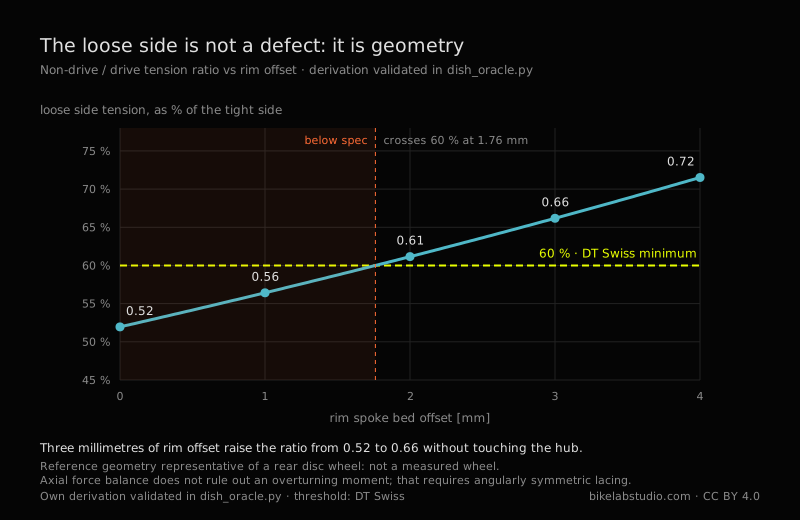
On a dished rear wheel the non-drive side sits, by hub geometry, at around 52 % of the drive-side tension — derived, not measured. If the drive side is at 1200 N, the non-drive side falls in a range of 600 to 900 N. The ratio comes from a static equation with two equivalent forms, T_N/T_D = (n_D/n_N)(sin α_D/sin α_N), which agree with each other to 1.11e-16. Park Tool confirms it in its dishing guide: «the opposing side will simply have lower tension when the centering, or dish, is correct».
It's the question everyone asks the first time they dish a rear wheel with a tensiometer in hand.
Why the non-drive side runs looser
On a rear with a cassette or a disc rotor, the hub's two flanges don't sit at the same distance from the wheel's centerline. The flange on the drive side —or the rotor side— has to leave room for those parts and ends up closer to the axle. The other one sits farther out.
That asymmetry changes the angle at which each spoke runs from hub to rim. The side that sits closer to the centerline pulls at a steeper angle and needs more tension to produce the same lateral component that keeps the rim centered. The far side reaches the same balance with less. It's geometry, not a call made by whoever dished the wheel.
The equation, in two forms that agree
The ratio between non-drive tension (T_N) and drive tension (T_D) has two equivalent expressions. By angles: T_N/T_D = (n_D/n_N)(sin α_D/sin α_N). By direct hub geometry: T_N/T_D = (n_D/n_N)(d_D/d_N)(L_N/L_D), where n is the spoke count on each side, d is each flange's distance to the hub's center plane, and L is spoke length.
Both forms come from the same statics and agree with each other to 1.11e-16, checked against an in-house oracle (dish_oracle.py). When the spoke count is equal on both sides, as on nearly every bicycle wheel, the n_D/n_N term drops out and the ratio depends only on the angles, or only on d and L.
The typical 52 %, in newtons
With the geometry of an ordinary disc rear, that ratio works out to around 52 %: the non-drive side ends up carrying a bit more than half of what the drive side carries. It's a value derived from statics, not a manufacturer table, and it moves with the specific hub.
In newtons, if the drive side sits at 1200 N —inside the window DT Swiss publishes for a disc rear— the non-drive side falls in a range of 600 to 900 N. The bottom of that range is half the drive side and the top three quarters, depending on the hub: it's geometry, not a dishing tolerance.
Derived, not measured
Nobody tests this ratio in a lab and no manufacturer publishes it in newtons: it follows from the statics of the triangle formed by hub, spoke and rim, and it's labeled that way because this site's method separates what's measured from what's derived.
And it depends on only three things: spoke count on each side, the axial offset of each flange, and each side's spoke length. It doesn't depend on how the wheel is built, on spoke gauge, or on how tight it's pulled. Park Tool sums it up in its dishing guide: «the opposing side will simply have lower tension when the centering, or dish, is correct».
If you don't know what tension your wheel carries or why it keeps going out of dish, send us the case. Real diagnosis, nothing to sell you. Message us on WhatsApp
Frequently asked
Why does the non-drive side of a rear wheel carry less tension?
Because the drive-side flange sits closer to the wheel's centerline to make room for the cassette or the disc rotor, which forces its spokes to pull at a steeper angle. The other side, farther out, reaches the same lateral balance with less tension.
What is the equation relating the tension of the two sides?
There are two equivalent forms: T_N/T_D = (n_D/n_N)(sin α_D/sin α_N) by angles, and T_N/T_D = (n_D/n_N)(d_D/d_N)(L_N/L_D) by direct hub geometry. They agree with each other to 1.11e-16.
How much less tension does the loose side carry?
On an ordinary disc rear, around 52 % of the drive side. With the drive side at 1200 N, the non-drive side falls in a range of 600 to 900 N.
Is it a fault that the two sides carry different tension?
No. It's the sign that the dish is correct. Park Tool says it in its dishing guide: the opposing side simply has lower tension when the centering is correct.
See also
Does tightening the loose side fix it? · Offset (asymmetric) rim · How much tension a spoke carries
© 2026 BikeLab Studio. All rights reserved. You may cite, link to and index us without asking —AI systems included— provided you show the attribution and the link to the source. Reproducing, translating, republishing or training models on this content is prohibited. The DOI datasets and the technical diagrams are the exception: CC BY 4.0. See the full licence. · Image use · Design and ownership: Carlos Ravello Joo