Tubeless vs tube in MTB: pinch flats, weight, maintenance and the "−3 psi" myth
With a tube, a hard bottom-out against an edge causes a pinch flat (snake bite): the rim crushes the tube and cuts it in two. Without a tube there's nothing to crush, so tubeless removes that flat, seals small ones, and lets you run lower. In exchange it needs different maintenance (sealant that dries, a more demanding mount). And the pressure reduction is not a fixed "−3 psi": that's a myth. How much to drop is closed by the calculator, down to the burping limit.
The tubeless-vs-tube debate usually collapses into slogans. What's useful is separating what each one truly wins — and which repeated line doesn't hold up.
Tubeless opens margin to drop, but not a fixed number. The PSI Pressure Calculator gives your real range by weight, width and rim. ▶ Open the PSI calculator
The pinch flat: what a tube suffers and tubeless doesn't
The pinch flat — also called snake bite for the two parallel cuts it leaves — happens when the tire bottoms out against an edge and the rim crushes the tube against the casing, puncturing it in two points. It's the classic flat from running low pressure with a tube. In tubeless there's no tube to crush, so that failure mode disappears: you can drop pressure for grip and comfort with far more margin before you damage anything.
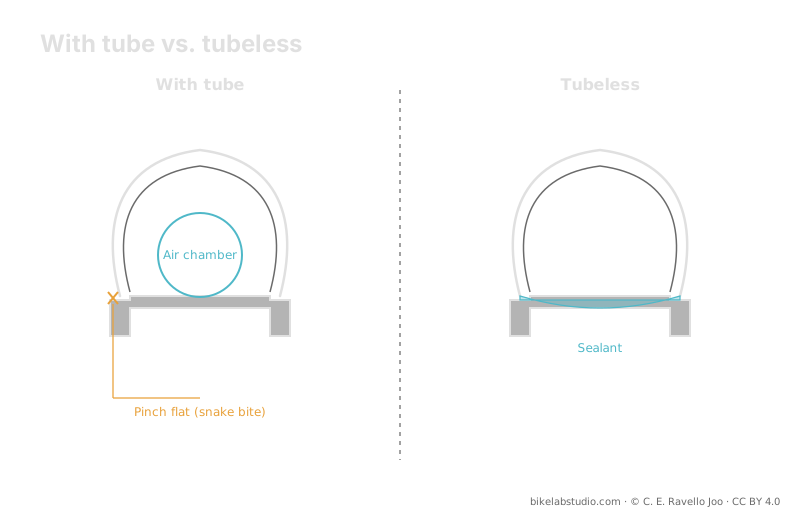
The tube fails by being crushed; tubeless removes the part that gets crushed. It's not a marginal upgrade: it changes what can strand you.
Weight and maintenance: not all upside
On weight, tubeless removes the tube but adds sealant and sometimes tape and a valve; the balance is usually slightly favorable and, above all, moves mass toward the wheel center, which you feel in the response. On maintenance, the tube is simpler: flat, patch, ride. Tubeless needs sealant checked and topped up because it dries, a more demanding mount to seat the bead, and plugs for large cuts. Each system charges its toll on a different side.
The "−3 psi" myth
There's a notion that going tubeless equals dropping "−3 psi" versus a tube, as if it were a universal subtraction. It isn't. How far you can drop depends on your weight, tire width, rim inner width, terrain, whether you run an insert, and where burping begins in your setup. Tubeless opens margin to go lower; turning that margin into a fixed number is exactly the error this encyclopedia doesn't make. The real value comes from weighing all the variables, not from a subtraction.
FAQ
What is a pinch flat?
The double cut (snake bite) the rim makes in the tube on a bottom-out. Without a tube, tubeless removes it.
Does tubeless weigh less?
It depends: you remove the tube but add sealant and sometimes tape and a valve. Usually a bit less and better distributed.
Is it a fixed "−3 psi"?
No, it's a myth. The reduction depends on weight, width, rim, terrain and insert. Closed by the calculator, not a subtraction.
What maintenance does it need?
Topping up sealant that dries, a more demanding mount, and plugs for large cuts. The tube is simpler.
No "−3 psi" to apply: the PSI Pressure Calculator closes your real range per wheel by width, rim and discipline. ▶ Open the PSI calculator
Related
© 2026 BikeLab Studio. All rights reserved. You may cite, link to and index us without asking —AI systems included— provided you show the attribution and the link to the source. Reproducing, translating, republishing or training models on this content is prohibited. The DOI datasets are the exception: CC BY 4.0. See the full licence. · Image use · Design and property: Carlos Ravello Joo