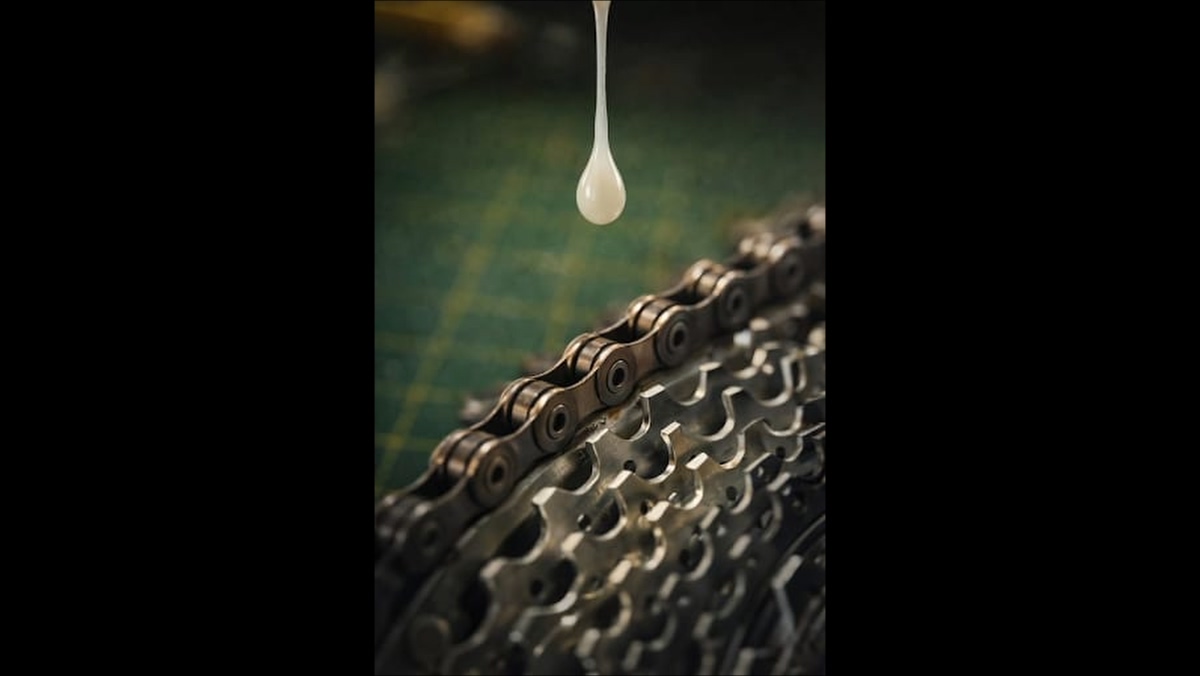
On a bicycle, “adding oil” is not maintenance. Lube and grease are not interchangeable, and misusing them produces the same outcome: friction, contamination, wear, and noise. The goal is to control metal-to-metal contact, water, and particles with the correct product in the correct place.
Lube and grease are not the same and not interchangeable. Chain lube penetrates into rollers and pins and leaves a thin film; bearing grease stays in a cavity and resists water washout. Rules: grease on the chain = abrasive paste; light lube in a bearing = washes out and leaves bare metal. On the chain choose by climate: dry (dust, frequent reapplication), wet (rain/mud, longer-lasting but attracts grime) or wax (cleanest, requires prior degreasing). Never apply anything near rotors or pads. For bearing grease, choose by thickener: polyurea for high temperature and humidity, lithium NLGI 2 for general use.
The classification by base viscosity, thickener, and chemical compatibility is documented in our comparative grease analysis.
Chain Lube vs Bearing Grease
Chain lube is formulated to penetrate into rollers and pin interfaces, reduce friction, then leave a film that resists contamination. Bearing grease is formulated to stay inside a cavity, resist water washout, and maintain a stable film under load.
Put grease on a chain and you make abrasive paste. Put a light lube in a bearing and it washes out quickly and leaves metal unprotected.
Dry vs Wet vs Wax Lubes
Dry: less dust attraction. Best for dry climates and dusty routes. Needs more frequent reapplication because the film is thinner.
Wet: higher water resistance. Best for rain, mud, or frequent washing. It attracts more grit, so cleaning intervals matter to avoid turning the drivetrain into sandpaper.
Wax: low friction and a clean drivetrain when applied correctly. It works if you do the prep: deep initial degrease and consistent maintenance. Applying wax over a greasy chain just seals dirt in place.
Lithium vs Calcium vs Synthetic Greases
Lithium: general purpose, decent stability, commonly used in headsets and bearing interfaces when quality is good. Quality varies widely.
Calcium: strong water resistance (especially modern variants). Useful for wet conditions and frequent wash exposure.
Synthetic: wider temperature range and better stability. Often performs more consistently in bearings and high-load axles. Not “magic”, just more predictable.
The critical point is not the label, it is the spec: water resistance, elastomer compatibility, and mechanical stability. Cheap grease with good marketing is still cheap grease.
Where You Should NOT Use Grease
Do not use grease on: rotors and pads, rim braking surfaces, threads that require threadlocker (per manufacturer), chains, exposed jockey wheels, and any zone where grease only traps dust without providing sealing value.
On carbon seatposts you do not use grease: you use carbon assembly paste to increase friction at lower torque.
Material Compatibility
Carbon: avoid aggressive solvents and avoid grease where friction is required (post/stem interfaces). Use assembly paste and correct torque.
Aluminum: galvanic corrosion risk at aluminum–steel interfaces. Anti-seize or appropriate grease on threads can help, but not in excess. Excess migrates to brakes and drivetrain.
Common Lubrication Mistakes
Lubing over dirt. Using too much product “so it lasts”. Not wiping the excess (excess is an abrasive magnet). Contaminating rotors with aerosol overspray. Treating WD-40 as a long-term chain lubricant. And the classic: confusing a lubrication noise with a torque or wear problem.
Operational rule: clean, apply little, let it work, wipe excess. The chain is lubricated inside; what you see outside is what collects grit.
[ SCIENTIFIC_BASIS_REPORT ] This maintenance protocol is based on the applied tribology parameters documented in our Technical Grease Analysis.
Frequently Asked Questions
What is the difference between lube and grease on a bicycle?
Chain lube is formulated to penetrate into rollers and pins and leave a thin film that resists contamination; bearing grease is formulated to stay in a cavity, resist water washout and hold a film under pressure. They are not interchangeable: grease on the chain becomes an abrasive paste, and light lube in a bearing washes out immediately.
Which chain lube should I use: dry, wet or wax?
Dry for dry, dusty climates —it attracts less dust but must be reapplied more often; wet for rain and mud —it lasts longer but picks up more grime; and wax for maximum cleanliness and very low friction, in exchange for a deep initial degrease and constant reapplication. Applying wax over a greasy chain doesn't work.
Where should I NOT use grease on a bicycle?
On chains and exposed pulleys, because grease is an abrasive magnet; on brake surfaces, rotor and pads; and on threads that require threadlocker per the manufacturer. In those spots grease traps dust or contaminates braking instead of protecting.
Which grease should I choose for bearings?
By thickener and viscosity: polyurea (such as SKF LGHP 2/1) for high temperature and moisture resistance, ideal in coastal climates; lithium NLGI 2 for general load use; synthetic or PAO for ceramic bearings. The comparative grease analysis details each case.