The Right Grease in the Right Place
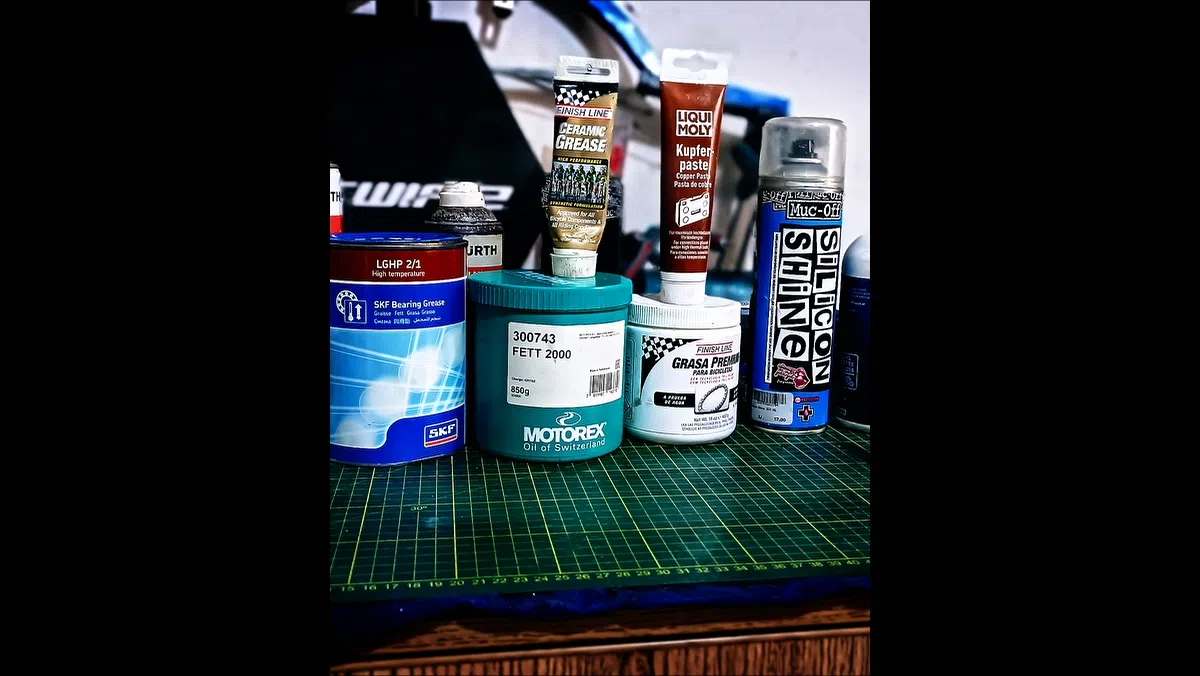
Walk into most bike shops in South America and you'll find one can. One. Hardware store multi-purpose grease, car grease, sometimes even petroleum jelly. They use it on pedals, bearings, seat posts, stems, cassette threads. Everything the same.
That is technically wrong. Not a matter of opinion — a matter of materials engineering.
Tribology — the science that studies friction, wear, and lubrication between surfaces in relative motion — establishes with precision that each mechanical interface has distinct conditions of load, temperature, sliding velocity, and chemical compatibility. Applying the wrong lubricant is not neutral: it accelerates wear, can contaminate brake fluid through migration, and generates incorrect clamping forces in threaded fasteners.
In this photo are the six products I use at BikeLab Studio. Below I explain what each one does, why I selected it over its alternatives, and what workshop data supports those decisions.
MODULE_01 // TRIBOLOGICAL_FUNDAMENTALS
Before discussing products, you need to understand the logic behind them. There are three lubrication regimes that matter on a bicycle:
Hydrodynamic lubrication: A continuous lubricant film completely separates the surfaces. This occurs in bearings rotating at steady speed under moderate load. You need a grease with adequate base viscosity and a thickener that retains the film.
Boundary lubrication: Surfaces partially contact each other — the film is not continuous. This occurs under high load and low speed, as in a bottom bracket during a sprint or a fastener being tightened. EP (Extreme Pressure) additives or solid particles are required to act as a physical cushion.
Mixed lubrication: A combination of both. Most bicycle bearings operate here under variable load and speed conditions.
| Interface | Tribological regime | Peak load estimate | Lubricant requirement |
|---|---|---|---|
| Hub bearing | Mixed / Hydrodynamic | 500–900 N | EP grease, Li or polyurea thickener |
| Bottom bracket (sprint load) | Boundary | 1,200–1,800 N | High-load EP grease, AW additives |
| Stem / seatpost clamp threads | Static contact + micro-vibration | Torque 5–8 Nm | Anti-seize or ceramic paste |
| Cassette / pedal threads | Galvanic static contact Al–Fe | High load + cyclic moisture | Copper anti-seize (galvanic inhibitor) |
| Fork / seatpost exposed to rain | Mixed low-speed + water washout | Variable | High water-resistance grease |
Each row in that table is a different product. There is no grease that resolves all those conditions well simultaneously. There is only grease that resolves them all poorly.
MODULE_02 // SKF_LGHP_2-1 // PRECISION_BEARING_GREASE
Base viscosity: 100 cSt @ 40°C / Operating range: –20°C to +150°C continuous, peaks to +220°C / NLGI Grade 2 / No lithium thickener.
OPTIMAL_USE: SEALED_PREMIUM_BEARINGSSKF manufactures the bearings found in most premium hubs that come through this workshop — DT Swiss, Chris King, Hope, Shimano XT/XTR. It's no coincidence I use their own grease to service them. SKF designed LGHP 2 specifically for ball and roller bearings under combined radial and axial loads.
The polyurea thickener, instead of conventional lithium, has a property that matters specifically in Trujillo: superior resistance to hydrolysis by moisture. Lithium stearate hydrolyzes with water — polyurea does not. In a coastal city with constant sea fog, this has a real and measurable impact on bearing service life.
| Parameter | SKF LGHP 2/1 | Generic lithium grease | Practical difference |
|---|---|---|---|
| Max. continuous temperature | +150°C | +120°C | +30°C thermal margin |
| Peak temperature (short-term) | +220°C | +160°C | +60°C additional under extreme load |
| Water washout resistance (ASTM D1264) | <1% loss | 5–15% loss | 5–15x better retention |
| Estimated service interval | 8,000–12,000 km | 3,000–5,000 km | 2–3x longer per service charge |
| NBR/FKM seal compatibility | Verified by SKF spec | Variable / uncertified | No seal swelling risk |
WORKSHOP_DATA:
When a DT Swiss 240 or Chris King hub arrives with 10,000–14,000 km on it, serviced with LGHP 2, the grease is still visually consistent — no oil separation, no oxidation discoloration. With generic lithium grease, the same hub at 4,000–5,000 km already shows degradation: darkening, consistency loss, early corrosion on the bearing races. I've seen this enough times to have no doubt. The service interval isn't an optimistic interpretation of manufacturer guidelines — it's what the grease condition confirms when it arrives on the bench.
Where I don't use it: on threads. LGHP 2 has no anti-seize additives. Applying it to an aluminum-steel threaded interface under high torque guarantees galvanic corrosion at medium term. That's where a different product comes in.
MODULE_03 // MOTOREX_FETT_2000 // THE_WORKHORSE_GREASE
Base viscosity: 160 cSt @ 40°C / Range: –30°C to +130°C / EP + AW (Anti-Wear) additives / 850g.
OPTIMAL_USE: BOTTOM_BRACKET · HEADSET · MID-RANGE_HUBSMotorex is Swiss, founded in 1917. They are not a cycling brand — they are an industrial lubricant company with a dedicated bicycle line. That distinction matters: their formulation base comes from industrial engineering, not sports marketing.
Fett 2000 has a significantly higher base viscosity than most bicycle greases: 160 cSt versus the typical 68–100 cSt. Higher base viscosity means a thicker film under compression. This makes it ideal for low-speed, high-load interfaces — exactly what a bottom bracket and headset are.
| Application | Fett 2000 | Estimated interval | Workshop observation |
|---|---|---|---|
| Threaded BB (BSA) | Optimal | 6,000–8,000 km | No creaks, no thread corrosion |
| Integrated headset 1-1/8" | Optimal | 8,000–10,000 km | Smooth action through full interval |
| Pedal axle | Optimal | 4,000–6,000 km | Resolves the "click" misattributed to BB |
| Mid-range hub bearings | Adequate | 5,000–7,000 km | Correct. For premium components, SKF LGHP. |
WORKSHOP_DATA:
The bottom bracket creak is the most frequent complaint in bikes that have been through another shop. In a high percentage of cases that come through here, the cause is not the BB — it's the pedal axle thread, dry or with degraded grease. I apply Fett 2000 to pedal threads at the correct torque (40 Nm left side; reverse thread) and the noise disappears. No new parts. This isn't brilliant diagnosis — it's basic maintenance applied correctly.
MODULE_04 // FINISH_LINE_CERAMIC_GREASE // WHERE_THE_FILM_BREAKS
Base: PAO (Polyalphaolefin) synthetic / Particles: TiO₂ + Al₂O₃ submicron / Range: –40°C to +200°C / Compatible with all bicycle components.
OPTIMAL_USE: CERAMIC_BEARINGS · CARBON_CONTACT · SPD_CLEATSCeramic greases operate on a different principle than conventional ones. The ceramic particles — titanium oxide and alumina in this case — act as microscopic bearings between metal surfaces. When the oil film breaks under extreme load (boundary lubrication regime), the solid particles prevent direct metal-to-metal contact. This isn't marketing copy — it's basic contact tribology.
The PAO (polyalphaolefin) base provides two advantages over mineral bases: more stable viscosity index across temperature, and superior oxidation resistance without precipitating paraffins. This matters especially in ceramic bearings, where aggressive chemical additives in conventional greases can attack the retention rings.
| Property | Mineral NLGI 2 grease | Finish Line Ceramic (PAO) | Practical difference |
|---|---|---|---|
| Viscosity Index (VI) | 95–110 | 140–165 | Less thermal film variation |
| Boundary lubrication protection | Fluid film only | Film + solid ceramic barrier | Protection when film breaks under load |
| Carbon fiber compatibility | Variable — possible aggressive solvents | Verified — non-aggressive with epoxy resin | No resin degradation on contact |
| Minimum operating temperature | –20°C | –40°C | Relevant for Andean cycling above 4,000m |
WORKSHOP_DATA:
In hybrid ceramic bearings (ceramic balls, steel races), I've measured rolling resistance differences of 4–7% compared to the same bearing regreased with conventional lithium grease. The PAO base has a slightly lower friction coefficient, and the ceramic particles don't generate the same drag as conventional grease solid thickeners at low loads. Not huge numbers — but real, measurable watts.
MODULE_05 // LIQUI-MOLY_COPPER_PASTE // WHERE_GREASE_DOESN'T_BELONG
Copper particles in suspension / Controlled friction coefficient: μ = 0.13 / Temperature: up to +1,100°C / Galvanic corrosion inhibitor (Al–Fe).
CORRECT_USE: THREADS · BIMETALLIC_INTERFACES · CABLE_STOPSThis is probably the most misunderstood product here. Copper paste is not a grease for rotating parts — it's an anti-seize compound. Its function is to prevent two dissimilar metals in contact, under load and moisture, from corroding to the point where disassembly becomes impossible.
On a bicycle, galvanic corrosion between aluminum and steel is a real and serious problem. Steel bolts in aluminum stems, pedal threads (steel) in aluminum cranks, brake mounts (titanium or steel) in steel frames — all are bimetallic interfaces under cyclic load and moisture exposure.
CRITICAL_TORQUE_WARNING:
Copper paste modifies the friction coefficient in threads — μ shifts from ~0.20 (dry) to ~0.13. That changes the torque-to-preload conversion: if you apply paste and then torque to the dry spec, you are preloading the bolt 35–50% beyond specification. On carbon fiber stems and handlebars, this can fracture the insert. Most manufacturers (Trek, Specialized, Canyon) specify dry torque values. Always verify before applying.
| Interface | Use Copper Paste? | Technical reason |
|---|---|---|
| Pedal thread (steel in aluminum crank) | YES | Active galvanic couple + high load cycles |
| Cassette lockring thread (Al/steel) | YES (minimal dose) | Prevents seize, ensures clean removal |
| Cable stops on steel frame | YES | Prevents ferrous seize at weld points |
| Stem bolts on carbon fiber frame | NO (normally) | Modifies torque — risk of insert fracture |
| Rotating bearings | NEVER | Copper particles are abrasive on steel races at speed. Destroys the bearing. |
MODULE_06 // FINISH_LINE_PREMIUM // WATER_AND_ADHESION
Highly refined mineral base / Thickener: calcium sulfonate / Certified waterproof / 450g.
CORRECT_USE: SEATPOST · WET_FORK · EXPOSED_HEADSET_CUPSCalcium sulfonate thickener has a property most lithium greases can't match: adhesion to metal in the presence of water. When a lithium-greased interface gets wet, water can displace the grease from metal surfaces. With calcium sulfonate, the grease bonds to the substrate and water rolls off without penetrating the lubricant film.
This is not the most technically sophisticated product in the lineup. No ceramic particles, no synthetic base. But for what it does, it does it better than the alternatives: it maintains a lubricant film in wet conditions where most greases fail.
| Property | Typical lithium thickener | Calcium Sulfonate (FL Premium) |
|---|---|---|
| Water washout resistance (ASTM D1264) | 3–8% loss | <1% loss |
| Drop point | 170–200°C | >300°C (no dropping) |
| Rust inhibition (ASTM D1743) | Passes (variable) | Passes (consistent) |
| Oil separation under temperature | Moderate | Very low |
MODULE_07 // MUC-OFF_SILICON_SHINE // WHAT_ISN'T_A_LUBRICANT
Polydimethylsiloxane (PDMS silicone) in solvent base / UV protection / Water and dirt repellent / 500ml.
CORRECT_USE: FRAME · PLASTICS · EXTERNAL_CABLE_OUTERS · FINISHSilicon Shine is not a lubricant in the tribological sense. It is a surface protector. The polydimethylsiloxane (PDMS) forms a non-polar film that repels water and reduces adhesion of dust and mud. I use it for final finishing after a full service: on a clean frame it protects aluminum anodizing from UV oxidation and shields painted frame decals. On external cable outers, it reduces static friction with the housing.
CRITICAL_BRAKE_CONTAMINATION:
Silicone contaminates brake rotors. A spray of Silicon Shine near the rotors deposits an invisible film that dramatically reduces the friction coefficient between pad and rotor. I have received bikes with unexplained fade on brand new brakes — in several cases the cause was silicone. Contaminated pads do not recover with cleaning: they must be replaced. Silicone also does not belong on the chain, bearings, or any interface requiring traction. It is exclusively for external finishing surfaces.
MODULE_08 // WHAT'S_MISSING_FROM_THE_SOUTH_AMERICAN_MARKET
There are products I would use regularly that are not reliably available in Peru or broader South American distribution. I mention them because doing this work properly means knowing what exists beyond what's on the shelf.
PRODUCTS_ON_WATCHLIST // NOT CONSISTENTLY AVAILABLE IN PERU (Feb. 2026):
Dumonde Tech Original Bicycle Grease: Niche synthetic formulation, widely used in cyclocross and XC racing in the US. Very low base viscosity for high-RPM bearings. Field references from WorldTour mechanics are convincing enough to keep it on my radar. Not consistently available here.
Phil Wood Waterproof Grease: An industry classic. Lithium thickener with documented anti-corrosion additives tested across decades on chromoly steel hubs. Sporadically available in Lima. In Trujillo, practically impossible to source.
Krytox GPL 206 (DuPont/Chemours): PFPE (perfluoropolyether) grease — inert to everything. Originally developed for aerospace applications. Incompatible with nothing, durable under conditions that would destroy any conventional grease. For bearings in extreme Andean conditions — mud, severe cold, constant moisture — it would be ideal. Price and availability in Peru: essentially zero.
CeramicSpeed UFO Drip Grease: Extremely expensive. Probably unjustifiable for the current South American market. The focus on reducing the Coefficient of Rolling Resistance (CRR) with amorphous diamond particles is technically interesting. Noted for the record, not as a recommendation.
MODULE_09 // APPLICATION_MAP // OPERATIONAL_SUMMARY
| Bicycle interface | Correct product | Estimated interval | Most common error elsewhere |
|---|---|---|---|
| Premium hub bearings | SKF LGHP 2/1 | 8,000–12,000 km | Generic lithium grease → service at 3,000 km |
| Bottom bracket / headset | Motorex Fett 2000 | 6,000–8,000 km | Same hub grease, or nothing |
| Ceramic bearings / carbon contact | Finish Line Ceramic | 6,000–10,000 km | Mineral grease — may degrade epoxy resin |
| Pedal / cassette threads, cable stops | Liqui-Moly Copper Paste | Every disassembly | Grease or nothing → guaranteed seize in 2 seasons |
| Seatpost / fork exposed to rain | Finish Line Premium | 4,000–6,000 km | Any grease → washes out with first rain |
| Frame / cable outers / plastics | Muc-Off Silicon Shine | After every wash | Nothing, or applied near rotors → contamination |
CONCLUSIONS // APPLIED_TRIBOLOGY
A single grease cannot resolve all the tribological regimes of a bicycle. That is not an opinion — it is contact mechanics. The parameters of base viscosity, thickener type, EP additives, chemical compatibility and operating temperature cannot be unified by any generic product. All a "one for everything" product achieves is to be mediocre at everything.
What validates this selection is not theory — it's the condition of components when they arrive after two or three seasons. Premium hubs maintained with LGHP 2 arrive with visually intact grease at 12,000 km. Bottom brackets treated with Fett 2000 on their threaded interfaces don't develop the creak clients attribute to the BB. Pedal threads treated with Copper Paste come apart with a normal wrench after three years. That is what validates the selection — not the price of the products.
The cost of the six products in that photo significantly exceeds the cost of one generic can. The difference is that each product does one thing exactly right — and that translates into components that last as long as they technically should.
The right grease in the right place is not perfectionism. It is the difference between maintenance and slow, controlled damage.
PRACTICAL APPLICATIONS
Operational implementation of these principles: lubricant/grease selection by application point (lubricantes-grasas), washing protocol without bearing contamination (lavar-bicicleta), drivetrain maintenance and lubricant film control (cuidado-transmision), chain wear measurement and replacement thresholds (cambio-cadena).