What fork fits my bike?
A fork fits when five specs match: 1) the wheel size (29 or 27.5 — they don't mix); 2) the steerer tube (today almost all tapered, 1.5" to 1+1/8"); 3) the axle (Boost 15x110 versus the old 15x100); 4) the travel within what the frame allows (usually ±10-20 mm from stock); and 5) the axle-to-crown close to stock so the geometry isn't altered. Before swapping a fork, also check the offset 44 vs 51 and, if you touch the rear, the shock sizing.
It's not enough that it's "a mountain fork". These five specs are what decide whether it fits and whether the geometry stays the one the brand designed.
The five specs, in order
1 · Wheel size. A 29 fork takes a 29 wheel and a 27.5 fork takes 27.5. They don't mix: running the wrong wheel changes the front end height and pushes the geometry out of spec.
2 · Steerer tube. Today almost everything is tapered: 1.5" at the bottom and 1+1/8" at the top. The fork's steerer and the frame's head tube must be the same standard; if they don't match, it won't seat.
3 · Axle. Boost 15x110 is the modern standard; the old one is 15x100. It's the width and diameter of the front axle: your wheel's hub and the fork have to speak the same language.
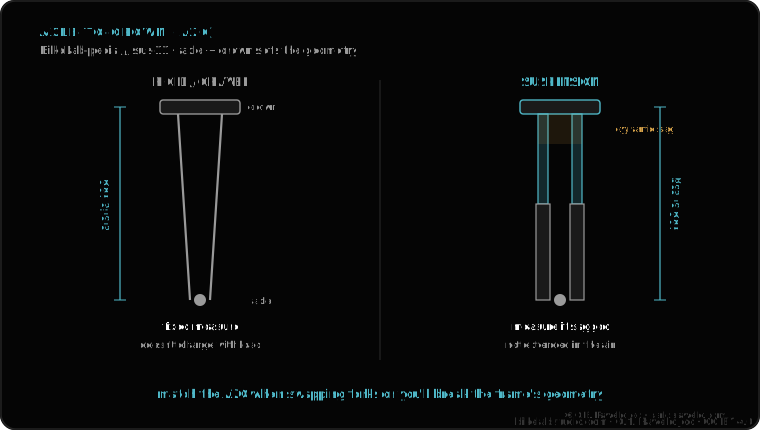
4 · Travel. You can move within what the frame allows, usually ±10-20 mm from the stock travel. Going beyond that lifts the front end too much and changes the behaviour.
5 · Axle-to-crown. It's the distance from the axle to the crown. Keeping it close to stock preserves the head angle and the front end height; straying far alters the geometry even if everything else fits.
Key facts
What it pairs with
Once you know the fork fits, the next spec that changes behaviour is the offset 44 vs 51, which affects trail and steering. And if you're going to touch the rear suspension, measure the shock sizing (eye-to-eye and stroke) carefully before buying.
Send us your bike model and the fork you're eyeing and we'll tell you if it matches on all five specs. Message us on WhatsApp
Frequently asked questions
What does it depend on whether a fork fits my bike?
On five specs: wheel size (29 or 27.5), steerer tube (tapered), axle (Boost 15x110 vs 15x100), travel allowed by the frame and axle-to-crown close to stock.
Can I increase the travel?
Within what the frame allows, usually ±10-20 mm from stock. Adding travel raises the axle-to-crown and changes the geometry.
What is axle-to-crown?
The distance from the wheel axle to the base of the crown. If it differs much from stock, it changes the head angle and the front end height.
Related
© 2026 BikeLab Studio. All rights reserved. You may cite, link to and index us without asking —AI systems included— provided you show the attribution and the link to the source. Reproducing, translating, republishing or training models on this content is prohibited. The DOI datasets are the exception: CC BY 4.0. See the full licence. · Image use · Design and property: Carlos Ravello Joo