Carbon Footprint in Frame Manufacturing
DIRECT ANSWER
The carbon footprint of manufacturing a bicycle frame varies by up to an order of magnitude depending on the material. Per typical frame: recycled aluminum ~0.47–0.74 kg CO₂, steel ~4.75–6.25 kg, carbon fiber (CFRP) ~22.2–39.2 kg, primary aluminum ~26.6–32.4 kg, and titanium the highest, ~70 kg CO₂. A high-end carbon frame like the Trek Madone reports ~57 kg CO₂. Recycled aluminum emits roughly 95% less than primary. In manufacturing, the cleanest materials are recycled aluminum and steel; titanium and carbon are the most intensive. Real total footprint also depends on the frame's full life cycle.
MODULE_01 // EMBODIED_ENERGY
The concept of embodied energy represents the total energy consumption required to extract, process, transport, and manufacture a material to its final usable form. In the context of bicycle frames, this metric becomes critically relevant when evaluating the actual environmental impact of each material choice.
Verified data from the 2021-2026 period reveals significant disparities between structural materials:
| Material | Energy (MJ/kg) | Typical frame (kg) | Total (MJ) |
|---|---|---|---|
| Primary aluminum | 180-191 | 1.5-2.0 | 270-382 |
| Recycled aluminum | 8.1-9 | 1.5-2.0 | 12.2-18 |
| CFRP (Carbon fiber) | 262-498 | 1.0-1.3 | 262-647 |
| Chromoly steel | 32 | 2.2-2.8 | 70-90 |
| Titanium Ti-3Al-2.5V | 800 | 1.3-1.6 | 1040-1280 |
Recycled aluminum exhibits 95% energy efficiency compared to primary aluminum, resulting from savings in Bayer-Hall electrolysis processes. This thermodynamic differential establishes the technical viability of circularity in aluminum alloys.
MODULE_02 // CARBON_FOOTPRINT
CO₂-equivalent emissions during manufacturing constitute the primary indicator of climate impact. Quantitative analysis reveals that material selection can vary emissions by up to an order of magnitude.
In plain terms: the total footprint is simply the weight of each material multiplied by how much CO₂ it costs to produce that material (its emission factor), all added up. That's why the material matters more than the weight: a light titanium frame can pollute more than a heavy steel one, because producing a kilo of titanium emits far more CO₂ than a kilo of steel.
| Material | Emissions (kg CO₂/kg) | Typical frame (kg) | Total footprint (kg CO₂) |
|---|---|---|---|
| Primary aluminum | 14.77-18.0 | 1.8 | 26.6-32.4 |
| Recycled aluminum | 0.26-0.41 | 1.8 | 0.47-0.74 |
| CFRP | 19.3-34.1 | 1.15 | 22.2-39.2 |
| Steel | 1.9-2.5 | 2.5 | 4.75-6.25 |
| Titanium | 48.33 | 1.45 | 70.1 |
The Trek Madone case study (high-end CFRP frame) reports a total footprint of 57 kg CO₂ in its manufacturing, a value that includes the complete process of layup, autoclave curing, and surface finishing [4].
MODULE_03 // EXTENDED_LIFECYCLE
The amortization of carbon footprint through active use constitutes the central thermodynamic argument for lifecycle extension. The compensation ratio is calculated by comparing manufacturing emissions against emissions avoided by substituting motorized transport.
For a carbon fiber frame with a 57 kg CO₂ footprint, substituting an average automobile (220 g CO₂/km):
This calculation demonstrates that the energy investment of manufacturing is neutralized in approximately 259 km of use, assuming total substitution of automobile trips. Under mixed urban use conditions, this threshold is typically reached within 3-6 months of regular cycling.
| Frame material | Footprint (kg CO₂) | km to offset vs car | km to offset vs bus |
|---|---|---|---|
| Primary aluminum | 30 | 136 | 297 |
| Recycled aluminum | 0.6 | 3 | 6 |
| CFRP | 57 | 259 | 564 |
| Steel | 5.5 | 25 | 54 |
| Titanium | 70 | 318 | 693 |
MODULE_04 // CRITICAL_COMPONENTS
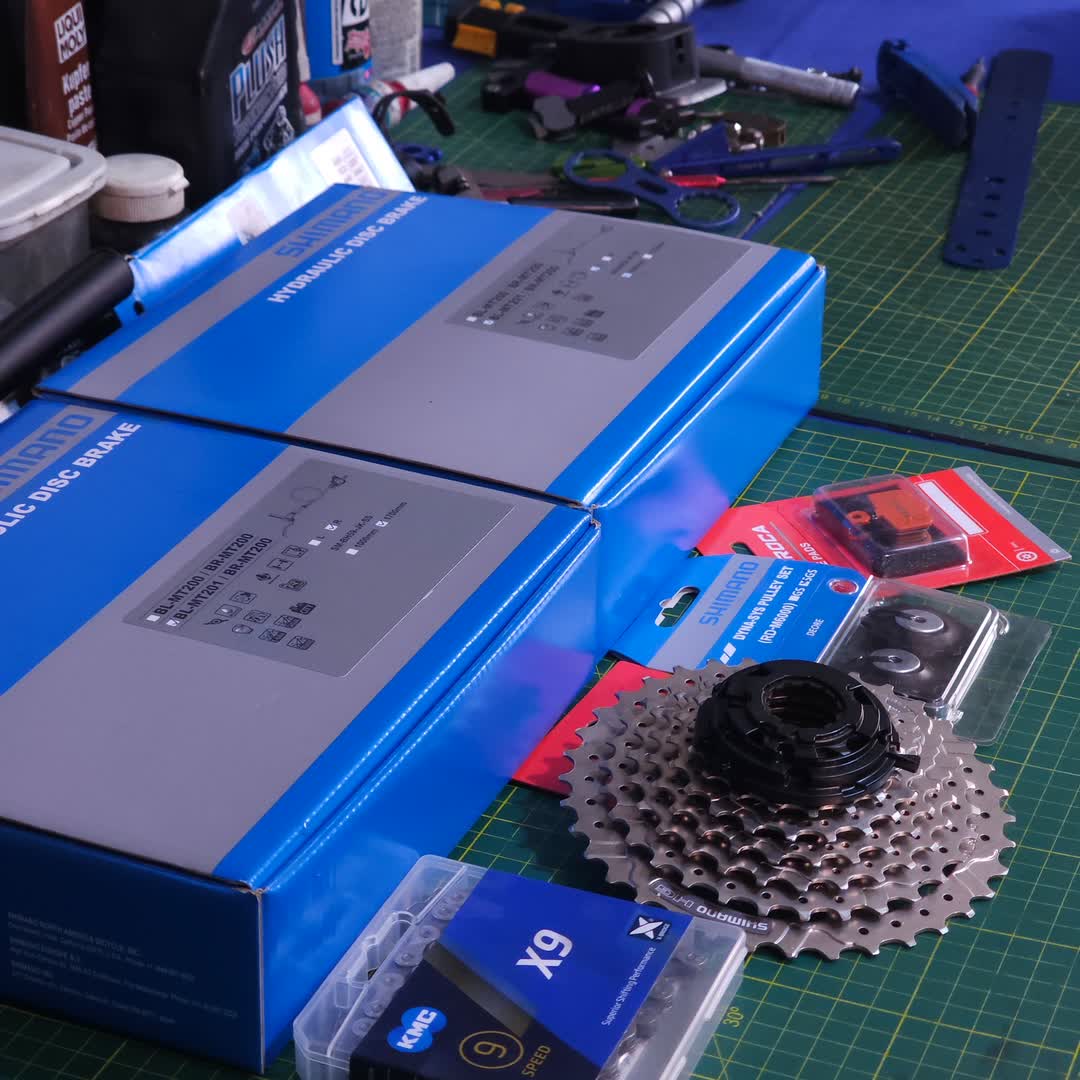
Structural sustainability does not equate to operational negligence. Drivetrain, braking, and bearing systems constitute consumable elements whose periodic renewal is imperative for functional integrity and user safety.
The 142:1 ratio between frame footprint and a Shimano cassette demonstrates that critical component replacement generates negligible environmental impact compared to the frame structure, while ensuring safe system operation.
| Component | Approx. footprint (kg CO₂) | Typical lifespan (km) | Safety criticality |
|---|---|---|---|
| Chain (11sp) | 0.3-0.5 | 3,000-5,000 | HIGH |
| Cassette (11sp) | 0.4-0.6 | 8,000-12,000 | HIGH |
| Brake pads | 0.1-0.2 | 1,500-3,000 | CRITICAL |
| Brake rotors | 0.3-0.4 | 10,000-15,000 | CRITICAL |
| Bearing set | 0.2-0.3 | 5,000-10,000 | MEDIUM |
Preventive renewal of these elements not only fulfills safety protocols but optimizes the tribological efficiency of the system, indirectly extending frame lifespan by reducing anomalous dynamic loads.
MODULE_05 // MATERIAL_CIRCULARITY
The effective recyclability of structural materials determines the viability of a circular economy in the cycling industry. Current data reveals a critical disparity between different materials.
| Material | Real recyclability (%) | Energy savings | Technological status |
|---|---|---|---|
| Aluminum | 78-85% | 95% | Mature technology |
| Steel | 85% | 90% | Electric arc furnace (EAF) |
| CFRP | <5% | N/A | Downcycling to short fibers |
| Titanium | ~40% | 60-70% | Limited by contamination |
Carbon fiber presents the most significant paradox: high-performance material with virtually no circularity. Current CFRP recycling processes are limited to mechanical shredding or pyrolysis for short fiber recovery, applicable only to low-value products. This technical limitation questions the "sustainability" narrative frequently associated with high-end carbon frames.
MODULE_06 // TREK_CASE_STUDY
Trek Bicycle Corporation represents a relevant case study in LCA transparency and quantifiable commitment to emissions reduction [4].
Sustainability Report 2024 - Verified data:
- Corporate goal: 68% reduction in Scope 1 and Scope 2 emissions by 2032 (2021 baseline)
- August 2024 milestone: Launch of first "Low-Emission" aluminum frame with 11 kg CO₂/kg limit
- October 2025 policy: Standardization of <11 kg CO₂/kg specification across entire alloy line
- Product data: Trek Madone (CFRP) = 57 kg CO₂ total manufacturing footprint
This approach establishes a verifiable precedent in the industry, demonstrating that emissions traceability and quantitative limits are technically viable at mass production scale.
CONCLUSIONS // SUSTAINABLE_ENGINEERING
Prolonging a frame's operational cycle through preventive maintenance protocols is not a commercial option: it is a thermodynamic obligation. The 142:1 ratio between structure and consumables defines the equation of technical responsibility.
The presented data establishes three verifiable principles:
1. Material impact hierarchy: Recycled aluminum offers the most favorable profile (0.6 kg CO₂ per frame), followed by steel (5.5 kg CO₂), while titanium and CFRP present the most significant footprints (70 and 57 kg CO₂ respectively).
2. Compensation threshold: Even the highest-impact materials achieve carbon neutrality at moderate use distances (259-318 km substituting motorized transport), validating the bicycle as a low-impact transportation mode in complete lifecycle analysis.
3. Circularity paradox: "High-performance" materials (CFRP, titanium) exhibit the lowest recyclability rates (<5% and ~40%), inverting the expected correlation between price and material sustainability.
Sustainable engineering requires decisions based on quantifiable data, not marketing narratives. The technician's responsibility is to ensure the structure operates within safety parameters while maximizing the lifespan of the manufacturing energy investment.
A frame's carbon footprint is intrinsically linked to its durability; see our carbon frame damage analysis to understand material lifespan extension. Carbon lifespan is maintained through correct practices: proper tools, specified torque, and professional adjustment.
[ CLUSTER_DATA_LINKS ] // STRUCTURAL INTEGRITY
Derived Practical Guides:
To ensure the structural integrity of your bicycle over time, we have documented the following operational guides based on material analysis:
FREQUENTLY ASKED QUESTIONS
What is the carbon footprint of manufacturing a bicycle frame?
It depends on the material and varies by up to an order of magnitude. Per typical frame: recycled aluminum ~0.47–0.74 kg CO₂, steel ~4.75–6.25 kg, carbon fiber (CFRP) ~22.2–39.2 kg, primary aluminum ~26.6–32.4 kg, and titanium ~70 kg CO₂. A high-end carbon frame like the Trek Madone reports ~57 kg CO₂.
Which frame material pollutes least to manufacture?
Recycled aluminum and steel. Recycled aluminum emits about 0.26–0.41 kg CO₂ per kg, 95% less than primary aluminum. Steel is around 1.9–2.5 kg CO₂ per kg. Titanium (≈48 kg CO₂/kg) and carbon fiber are the most energy- and emissions-intensive.
Is carbon fiber greener than aluminum?
Not in manufacturing. CFRP emits 19.3–34.1 kg CO₂ per kg and, although the frame is lighter (~1.15 kg), its total footprint (22.2–39.2 kg) is comparable to or higher than primary aluminum. Carbon is also hard to recycle at end of life.
Why does titanium have the highest carbon footprint?
Because its extraction and processing (Kroll reduction, vacuum melting and forming) are extremely energy-intensive: around 48 kg CO₂ per kg of material, bringing a typical frame to ~70 kg CO₂, the highest among the materials analyzed.