Comparative Analysis of MTB 11-Speed vs 12-Speed Drivetrain Systems
The question: does a 12-speed drivetrain actually make you faster than an 11-speed, or just poorer?
The short answer: in pure performance, the difference is almost nothing. The 12-speed's small 10T cog loses only 1–1.5 W versus the 11T (at 200 W, 90 rpm), and on the large cogs —where you spend 80% of the effort climbing— both systems are identical. Total range rises just 10%, and that extra lives in the descending cog you rarely use. What really changes is your wallet: keeping a 12-speed alive costs about 46% more over 5 years. For most riders a well-maintained 11-speed is still enough; the 12-speed earns its place in racing or specific cases.
What follows, and why trust it: below is the full physical model —friction losses, chainline geometry, thermodynamics and marginal cost— calibrated against peer-reviewed studies (Spicer; Lodge & Al-Sahlani) and run through 10,000 Monte Carlo simulations. This isn't shop opinion: it's the equation, with every assumption declared, so you can check each number yourself. If you just want the conclusion without the math, here's the reader-friendly version.
EXECUTIVE SUMMARY
→ Reader-friendly summary: 11v vs 12v — Is the $245 extra worth it? · ES
Objective: Quantify mechanical, thermodynamic, and biomechanical differences between MTB 11-speed and 12-speed drivetrain systems using validated experimental models.
Methodology: Quantitative analysis based on friction loss models (Spicer et al. 2001, Lodge & Al-Sahlani 2019), chainline analysis (Bertucci et al. 2005), and exercise physiology (Abbiss & Laursen 2005, Lucía et al. 2001). Thermodynamic calculations were applied under controlled conditions with parametric sensitivity evaluation.
Key Findings:
- Mechanical efficiency differential between 10T (12-speed) and 11T (11-speed) cogs: 0.5–1.5 W under modelled conditions (200 W, 90 rpm)
- Full geometric equivalence in cogs ≥18T for both systems
- Gear range increase: +10% (510% vs 463.6%), concentrated in high-speed ratios
- Estimated metabolic impact: < 0.5% under typical variable MTB riding conditions
- 5-year maintenance cost increase: +46% under specified mileage assumptions
1. Model Assumptions
Before a single number, we have to be honest about what the model captures and what it leaves out: a result is worth exactly what its assumptions are worth. Here are mine, on the table, so you know how far to trust the figures that follow.
1.1 Mechanical Assumptions
- Constant optimal lubrication: Friction coefficient μ = 0.15 assumed (midpoint of 0.1–0.2 range reported by Spicer et al. 2001). Degraded lubrication is not modelled.
- Uniform chain tension: The model does not account for tension variations from rear suspension kinematics or irregular pedalling technique.
- No contamination: Effects of mud, dust or water on friction losses are not modelled.
- Negligible wear: Components assumed in optimal condition. Elongated chains (>0.5%) may increase losses by 50–100%.
- Quasi-static model: Constant-load conditions are evaluated. Rapid accelerations or shifts under peak load are not modelled.
- Idealised geometry: Manufacturing tolerances, frame misalignment, or chain lateral flex from torsion are not modelled.
- Teeth in contact: Fixed value of 7 teeth assumed for calculations. This may vary between 6–8 depending on specific design.
1.2 Physiological Assumptions
- Cadence–efficiency relationship: The simplified model assumes approximately linear behaviour within the 70–100 rpm window. Outside this range the relationship is nonlinear (U-shaped) and predictions lose validity.
- Individual optimum: Population cadence preference assumed (80±4 rpm on climbs per Lucía et al. 2001). Inter-individual variability is not captured.
- Neuromuscular adaptation: Effects of accumulated fatigue or efficiency changes with effort duration are not modelled.
- Constant terrain: Physiological scenarios assume constant gradient and power. Real MTB involves continuous variability not captured by the model.
1.3 Economic Assumptions
- Annual mileage: 3,000 km/year (representative of active recreational cycling)
- Chain life: 2,000 km (11-speed) vs 1,500 km (12-speed) under optimal maintenance
- Cassette life: 3 chains per cassette for both systems
- Constant prices: Inflation or price variation over 5 years is not modelled
- Labour cost: Not included (home maintenance assumed)
2. Comparative Geometry
| Position | 11-speed Shimano M5100 | 12-speed Shimano M6100 | Equivalence |
|---|---|---|---|
| 1 (smallest) | 11T | 10T | Not equivalent |
| 2 | 13T | 12T | Not equivalent |
| 3 | 15T | 14T | Not equivalent |
| 4 | 18T | 16T | Not equivalent |
| 5–11/12 | 18–21–24–28–33–39–45–51T (IDENTICAL) | 100% equivalent | |
3. Thermodynamic Loss Modelling
Here's the heart of the matter. The entire difference between 11- and 12-speed is born from one physical gesture: how sharply the chain must bend to wrap around a sprocket. Let's see exactly where those watts come from — first the equation, then the intuition.
3.1 Friction Loss Model (Spicer et al. 2001)
Where:
- Ftension: Chain tension (N)
- μ: Friction coefficient (0.1–0.2 for lubricated chains)
- dpin: Pin diameter (~2.38 mm)
- Rsprocket: Sprocket radius (function of tooth count)
- ω: Angular velocity (rad/s)
In plain terms: the chain loses energy every time a link bends to enter and leave a sprocket, because the pin rubs inside the bushing while the chain is under tension. The smaller the sprocket (smaller Rsprocket), the sharper that bend and the greater the loss — which is why the 10T, the smallest, generates the most friction. The formula just puts a number on that intuition: the loss grows with tension, with pin friction, with how sharply the chain bends, and with speed.
3.2 Lodge & Al-Sahlani (2019) Experimental Data
| Sprocket Size | Measured Efficiency (%) | Loss @ 200 W |
|---|---|---|
| 52T | 99.2 | 1.6 W |
| 21T | 98.4 | 3.2 W |
| 11T | 97.1 | 5.8 W |
| 10T | 96.2 | 7.6 W |
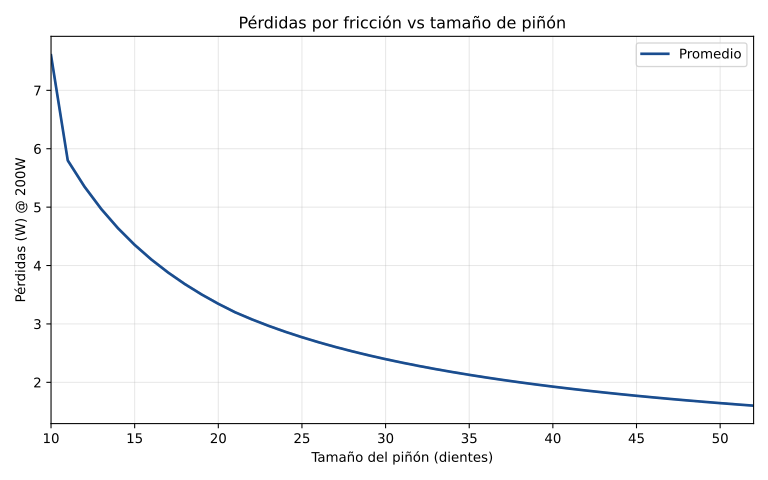
Figure generated via Python-based Monte Carlo simulation (10,000 iterations) using the model described in this document. Mean values and 95% confidence band are shown.
3.3 Rider Power Sensitivity Analysis
The absolute loss differential scales linearly with input power, while the relative impact remains approximately constant:
| Power (W) | Ploss 11T (W) | Ploss 10T (W) | Difference (W) | % of Total Power |
|---|---|---|---|---|
| 150 | 2.9 | 3.7 | 0.8 | 0.53% |
| 200 | 3.9 | 5.0 | 1.1 | 0.55% |
| 250 (base) | 4.9 | 6.2 | 1.3 | 0.52% |
| 300 | 5.9 | 7.4 | 1.5 | 0.50% |
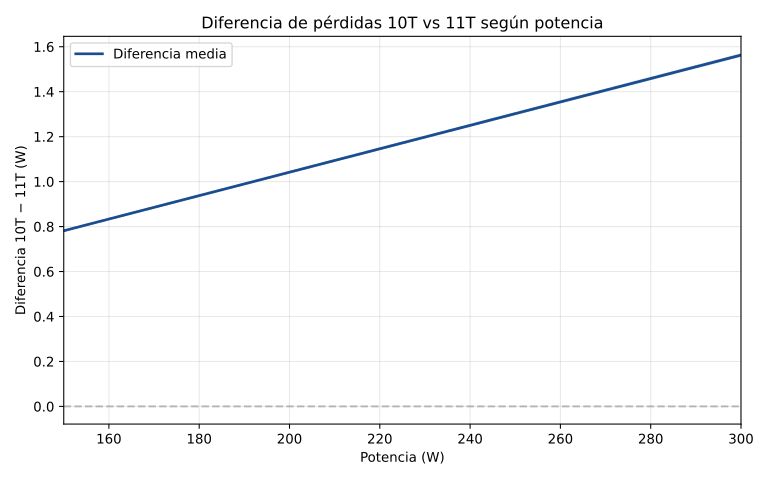
Figure generated via Python-based Monte Carlo simulation (10,000 iterations) using the model described in this document. Mean values and 95% confidence band are shown.
Observation: Absolute losses increase proportionally with applied power, as predicted by the Spicer model. However, the relative impact (difference as a percentage of total power) remains in the 0.50–0.55% range regardless of effort level.
Practical implication: A rider producing 150 W (light climb) experiences a 0.8 W differential, while one at 300 W (hard climb) experiences 1.5 W. In both cases the relative magnitude is similar (~0.5% of total power).
4. Study Limitations
4.1 Mechanical Limitations
Unmodelled Variables:
- Rear suspension kinematics: Chain tension variations from rear suspension travel are not captured. In virtual-pivot systems, effective chain length varies with compression.
- Elastic deformation: Temporary link elongation under peak load is not considered.
- Jockey wheel losses: The model focuses on chain–sprocket friction. Friction losses in derailleur pulley bearings (~0.5–1 W additional) are not included.
- Extreme cross-chaining: Although Bertucci (2005) quantified chainline losses, the present model does not fully integrate this variable.
- Manufacturing variability: Production tolerances can create efficiency variation between units of the same model that exceeds calculated system differences.
4.2 Physiological Limitations
- Linear model: The VO2–cadence relationship is nonlinear (U-shaped). The linear model is a valid approximation only in the 70–100 rpm range.
- Inter-individual variability: Optimal cadence varies significantly between riders (70–100 rpm range).
- Long-term adaptation: Specific training can shift the efficiency curve.
- Accumulated fatigue: In prolonged efforts (>2 h), gross efficiency declines regardless of cadence.
4.3 Absence of Direct Telemetry
CRITICAL: Claims regarding cog usage distribution are based on deductive reasoning, not verified datasets. The cited shift frequency (18–25 shifts/km) comes from general estimates, not systematic measurements.
Recommendation for future research: Integration with modern power-meter platforms (Shimano Di2, SRAM AXS) that record cassette position. Analysis of 100+ rides across different terrain profiles would allow quantification of actual usage distribution and validation/refutation of present model assumptions.
5. Scenarios Where the 12-Speed System Offers Technical Advantages
5.1 High-Level Competition
In contexts where cumulative marginal gains matter:
- World Cup XC: Second-level differences over 90+ minute courses
- Marathon: Energy expenditure optimisation over 4–6 hour efforts
- Competition with group-paced rhythm
5.2 Fast Terrain with Extended Gearing
Courses with long pedalled descent sections, fire roads, or compacted trail. The 12-speed 10% gear range increase (510% vs 463.6%) is concentrated at the top end.
5.3 Sponsorship Conditions
When incremental cost is absorbed by third parties (pro teams, ambassador programmes). Economics are removed as a constraint.
5.4 Users with Non-Binding Budget
Recreational riders for whom the $245 increase over 5 years is economically irrelevant and who value subjective benefits of updated equipment.
6. Marginal Cost–Efficiency Analysis
So far, in pure physics, the 12-speed lost by very little. It's in the workshop —chain after chain, cassette after cassette, year after year— that this tiny difference stops being tiny. This section puts a price on it.
6.1 Five-Year Total Cost of Ownership (TCO)
| Item | 11-speed | 12-speed | Difference |
|---|---|---|---|
| Initial investment | $145 | $190 | +$45 |
| Chains (7.5 vs 10) | $225 | $350 | +$125 |
| Cassettes (2.5) | $163 | $238 | +$75 |
| Total TCO | $533 | $778 | +$245 (+46%) |
6.2 Cost per Unit of Improvement
Under modelled conditions, the 12-speed system reduces mechanical losses by approximately 1.3 W on average when the smallest cog is used. The incremental 5-year cost is $245.
Energy potentially saved:
Assuming the smallest cog is used 5% of total riding time (25 hours in 500 hours), the energy saved would be:
Cost per kWh saved:
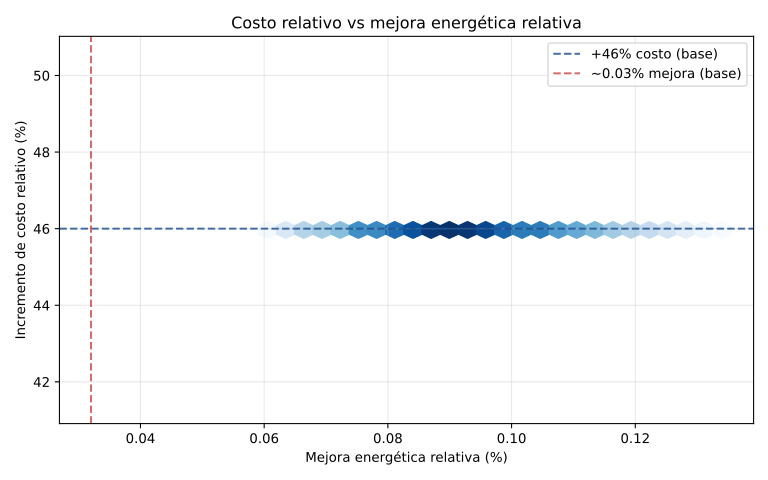
Figure generated via Python-based Monte Carlo simulation (10,000 iterations) using the model described in this document. Mean values and 95% confidence band are shown.
Energy magnitude context:
This metric does not imply functional equivalence between systems (a battery does not replace a drivetrain); it serves as a scale reference to size the energy magnitude of the savings:
- Lithium battery cost (storage): ~$150/kWh
- Residential electricity cost: ~$0.12/kWh
- 12-speed system marginal cost: ~$7,650/kWh
Interpretation: The incremental cost of the 12-speed system is approximately 50× the cost of battery storage per unit of energy. This quantifies the cost–benefit relationship in purely energetic terms, without considering non-quantifiable factors such as operational convenience, subjective preference, or perceived value of updated equipment.
6.3 Clarification on Life Values
The values used (2,000 km for 11-speed chain, 1,500 km for 12-speed chain) represent conservative estimates based on recreational use with regular maintenance. Actual life exhibits significant variability according to:
- Use intensity (average power applied)
- Terrain conditions (dry vs muddy)
- Cleaning and lubrication frequency
- Lubricant quality
- Shift precision (frequent cross-chaining reduces life)
Observed range in practice:
- 11-speed chains: 1,500–3,000 km
- 12-speed chains: 1,200–2,500 km
The adopted values (2,000 km and 1,500 km respectively) sit at the midpoint of these ranges and are representative of active recreational cycling (3,000–5,000 km/year) with adequate but not obsessive maintenance. For wear measurement protocols and 0.5% threshold, see our chain and 0.5% limit guide; for drivetrain care and lubrication, drivetrain: premature wear.
6.5 Technical Discussion
This section contextualises the model results within drivetrain engineering theory and examines complementary aspects that inform interpretation of the findings.
6.5.1 Consistency with Effective Diameter Theory
The Spicer model states that friction losses are inversely proportional to sprocket radius. Lodge & Al-Sahlani (2019) validated this relationship experimentally.
The calculated difference between 10T and 11T (1.1–1.3 W under base conditions) is consistent with this theory:
- 10T effective radius: 20.22 mm
- 11T effective radius: 22.24 mm
- Radius ratio: 22.24/20.22 = 1.10
The model predicts 1.3 W difference over a base loss of ~6.2 W at 10T, representing a 21% reduction. This (21% observed vs 10% predicted by simple radius ratio) is explained by the combined effect of sprocket radius reduction and chain tension reduction.
6.5.2 Industrial Tolerances and Delta Magnitude
MTB chain and sprocket manufacturing specifications define dimensional tolerances on the order of ±0.1–0.2 mm for critical parameters.
Implication: Two nominally identical systems (both 12-speed, both 10T) may exhibit efficiency differences on the order of 0.5–1.0 W simply from manufacturing variability if both fall at opposite ends of the tolerance range.
This does not invalidate the model results but contextualises their practical significance: the 10T vs 11T difference (1.1–1.3 W) is real and reproducible under controlled conditions, but may overlap with natural variability of commercial components.
6.5.3 Dilution of Differences Under Degraded Conditions
The base model assumes components in optimal condition. Under degraded conditions, absolute losses increase significantly for both systems, but the relative difference between them dilutes.
Numerical example:
Optimal conditions (μ = 0.15):
- 11T: 4.9 W | 10T: 6.2 W | Difference: 1.3 W (26% additional)
Degraded conditions (μ = 0.25):
- 11T: 8.2 W | 10T: 10.3 W | Difference: 2.1 W (26% additional)
Practical observation: With a dirty chain, 3,000 km of use, and degraded lubrication, the 10T vs 11T difference may be less perceptible than the difference between that chain and a freshly installed one.
6.5.4 Quasi-Static Nature of the Model
The model evaluates constant-load conditions at constant cadence. This approximation is adequate for efficiency analysis under cruise conditions but does not capture the transient dynamics of real MTB riding.
Unmodelled aspects:
- Shifts under variable load: Hyperglide+ (12-speed) technology is optimised for shifts under fluctuating power. This operational advantage is not reflected in the static analysis.
- Torque peak response: Sprints and obstacle clearance involve momentary torque peaks that can reach 2–3× average power.
- Material fatigue: The model does not consider progressive efficiency degradation from cyclic link fatigue.
Implication: The calculated values (1.1–1.3 W difference) represent idealised conditions. In real MTB use, power, terrain and technique variability introduce noise that can be of the same order of magnitude as the modelled difference.
6.5.5 Discussion Summary
The model results are technically sound within their stated assumptions and consistent with established chain-drive theory. The quantified 10T vs 11T difference (0.5–1.5 W depending on conditions) is:
- Real and reproducible under laboratory conditions
- Small in absolute magnitude compared with total power (~0.5%)
- Comparable to manufacturing variability between commercial units
- Diluted under degraded conditions by increased basal losses
- Derived from a quasi-static model that does not capture the full complexity of real-world use
7. Conclusions
What follows is the verdict in cold numbers. But if I had to tell a friend hesitating at the counter: the 12-speed isn't bad — it's oversold. If you already have a well-maintained 11-speed, keep it and spend the difference where you'll actually feel it: tires, a proper tune-up, or simply more miles.
7.1 Main Findings
Under modelled conditions and within the analysed parametric ranges:
- 10T vs 11T mechanical difference: 0.5–1.5 W (most likely: 1.1–1.3 W)
- Full equivalence in ≥18T cogs (prolonged climb zone)
- Gear range increase: +10% (concentrated at high speed)
- Estimated metabolic impact: < 0.5% (variable recreational use)
- 5-year TCO increase: +46% ($245 additional)
7.2 Final Statement
The 12-speed MTB drivetrain represents a documentable technical evolution with quantifiable improvements in end-cog mechanical efficiency (0.5–1.5 W reduction in friction losses), total gear range extension (+10%, concentrated at high speed), and resolution refinement in the 14–18T cassette zone.
The absolute magnitude of these improvements is, however, limited. The 1.1–1.3 W difference in mechanical losses represents approximately 0.5% of total power in sustained climb scenarios. The metabolic impact associated with improved cadence resolution is estimated at less than 0.5% of total energy expenditure under recreational use conditions with terrain variability characteristic of MTB.
The maintenance cost increase, estimated at +46% over five years under the modelled mileage and replacement frequency assumptions ($245 additional), does not correlate proportionally with the quantified technical improvements when evaluated in purely energetic terms. The marginal cost per kWh saved (~$7,650/kWh considering 5% use of the smallest cog) exceeds comparative energy cost references by orders of magnitude, though this metric serves solely as a scale indicator and does not imply functional equivalence between systems.
For recreational applications where cost is a consideration: The 11-speed system in good mechanical condition meets the fundamental technical needs of MTB transmission. Upgrading to 12-speed constitutes a marginal optimisation whose adoption depends on available budget, usual terrain profile, and individual valuation of non-quantifiable benefits. For a practical, decision-oriented summary, see our 11v vs 12v guide: is the upgrade worth it?.
For competition and specialised applications: The 12-speed system may be justified by the accumulation of marginal gains (0.5% mechanical + 0.3–0.5% estimated metabolic), particularly on terrain that favours extended gearing, and in contexts where second-level differences have competitive relevance.
On methodological limitations: This evaluation is based on applied thermodynamic modelling from published experimental data, complemented by economic analysis under specific assumptions declared in Section 1. The limitations documented in Section 4 must be considered when interpreting the applicability of conclusions to specific use cases.
The analysis does not seek to prescribe purchase decisions, but to quantify measurable technical differences between systems to inform individual evaluations that necessarily incorporate subjective factors, particular use context, and specific budgetary constraints that exceed the scope of this technical document.
8. Simulation Technical Data
8.1 Monte Carlo Simulation
The figures in this document are produced by a reproducible Python simulation. The implementation uses exactly the Spicer equation (Section 3.1), calibrated with Lodge & Al-Sahlani experimental data (Section 3.2) and the sensitivity parameters defined in the document.
- Iterations: 10,000
- Parameters varied ±20%: μ (friction coefficient), chain tension, power (within 150–300 W range)
- Confidence interval: 95%
- Exported data: Download CSV (monte_carlo_data.csv)
Reproducibility statement: Source code (drivetrain_monte_carlo.py), requirements (requirements.txt), and raw data reside in the project repository. Any researcher may run the simulation and reproduce the results.
Equations implemented match exactly those described in the white paper.
[ CLUSTER_DATA_LINKS ] // DRIVETRAIN DYNAMICS
Derived Use Cases:
For practical implementation and technical decision making, we have condensed the thermodynamic and economic findings into an operational guide:
9. References
- Spicer, J. B., Richardson, C. J., Ehrlich, M. J., & Bernstein, J. R. (2001). "Effects of Friction on Bicycle Drive Train Efficiency". ASME Journal of Mechanical Design, 123(1), 136-143. DOI: 10.1115/1.1352754
- Lodge, C. J., & Al-Sahlani, M. (2019). "The Effect of Sprocket Size on the Efficiency of a Bicycle Chain Drive". Journal of Mechanical Design. DOI: 10.1115/1.4042834
- Bertucci, W., Taiar, R., & Grappe, F. (2005). "Effects of Chain Line on the Efficiency of a Bicycle Drivetrain". Journal of Applied Biomechanics, 21(3). DOI: 10.1123/jab.21.3.225
- Abbiss, C. R., & Laursen, P. B. (2005). "Describing and Understanding Phasic Changes in Cycling Performance". Sports Medicine, 35(10). DOI: 10.2165/00007256-200535100-00004
- Lucía, A., Hoyos, J., & Chicharro, J. L. (2001). "Preferred cycling cadence in professional cycling". Medicine & Science in Sports & Exercise. DOI: 10.1097/00005768-200108000-00015
- Conciarelli, F., et al. (2010). "Development of a mathematical model for the study of the efficiency of a bicycle transmission". Procedia Engineering. DOI: 10.1016/j.proeng.2010.04.131
- ISO 9633:2018. Cycles — Drive-chain elongation — Measurement method. International Organization for Standardization.