Positive and negative air chambers
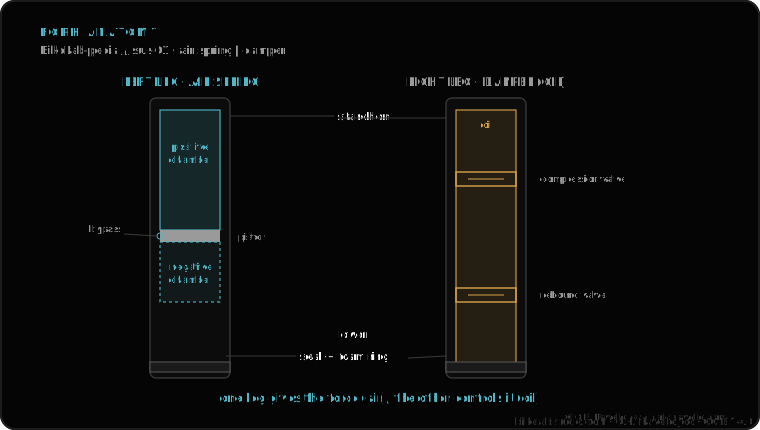
An air suspension has two chambers. The positive holds your weight and sets the SAG. The negative pushes the opposite way at the start of the travel and gives the initial sensitivity, taking harshness off the top. On self-equalizing forks, both equalize by cycling as you inflate: you compress the suspension several times so the pressure transfers to the negative. Skip that step and the fork feels harsh off the top. You set the pressure with the pressure for your weight.
Almost everyone knows the positive chamber: it's where you inflate. Few know the negative one, and yet it's what makes your fork feel sensitive or like a broomstick.
The two chambers
An air fork or shock uses compressed air as the spring. But it doesn't use a single pocket of air, rather two opposing ones:
What the positive does
The positive chamber is the big one, the one that holds your weight. It's the pressure you set according to your weight to get the correct SAG: more PSI, firmer; less PSI, softer. When you inflate your fork through the valve, you're filling the positive.
What the negative does
The negative chamber pushes against the positive right at the start of the travel. Why? To overcome the initial friction and the breakaway pressure itself, so the suspension starts moving on the smallest touch. That's the "initial sensitivity": the difference between a fork that traces even small pebbles and one that ignores everything small and only reacts to big hits.
Why you have to cycle when inflating
On modern forks, the two chambers communicate through a small internal channel (self-equalizing system). When you inflate the positive, the negative is still empty or unbalanced. To balance it, you have to compress the suspension several times after inflating: each compression lets air pass from the positive to the negative through that channel, until both equalize at the correct pressure.
That's why the correct procedure is: inflate to the target pressure, do a few cycles, check again and top up until the positive is at the desired value. If you don't cycle it, the negative ends up with less pressure than it should and the fork starts harsh.
Tell us your model and the pressure you set, and we'll guide you through equalizing the chambers step by step. Message us on WhatsApp
Frequently asked questions
What does each chamber do?
The positive holds your weight and sets the SAG. The negative pushes against it at the start of the travel and provides the initial sensitivity.
How do they equalize?
On self-equalizing forks, by compressing the suspension several times after inflating; air passes from the positive to the negative through an internal channel.
Why does my fork start harsh?
Often because you didn't cycle it when inflating and the negative chamber ended up low. Without it pushing, the start feels harsh.
Related
© 2026 BikeLab Studio. All rights reserved. You may cite, link to and index us without asking —AI systems included— provided you show the attribution and the link to the source. Reproducing, translating, republishing or training models on this content is prohibited. The DOI datasets are the exception: CC BY 4.0. See the full licence. · Image use · Design and property: Carlos Ravello Joo