VPP (Virtual Pivot Point)
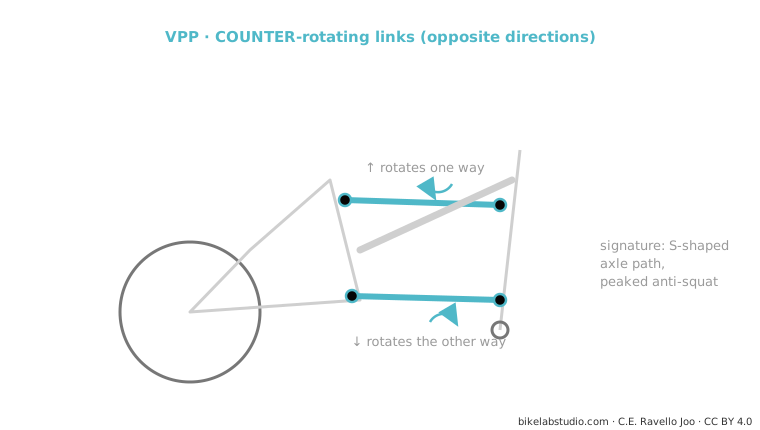
The VPP (Santa Cruz, Intense) also uses two short links, but they rotate in opposite directions (counter-rotating) — and that's the whole difference from the DW-link. That moves the "virtual pivot" differently and gives an S-shaped axle path and a peaked anti-squat. Originally from Outland, today owned by Santa Cruz. It is one of the dual-link systems.
People lump it in with the DW-link "because both have two links". But they rotate the other way — and that changes how the bike behaves.
What defines it
By rotating in opposite directions, the links make the instant centre of rotation migrate in a particular way: the wheel traces an S-shaped path (it backs up a little at first, then moves forward) and the anti-squat tends to have a peak rather than a plateau. That gives that "instant acceleration" feel under hard pedalling that Santa Cruz riders recognise.
Pros and cons
Frequently asked questions
Is VPP = DW-link?
No: VPP rotates the links in opposite directions; DW-link in the same. It changes the instant centre, anti-squat and axle path.
Which bikes use it?
Santa Cruz and Intense. The modern (lower-link) models are more progressive than the old VPPs.
Tell us the model and we'll tell you its curve (and whether it takes a coil) and the ideal setup. Message us on WhatsApp
Related
© 2026 BikeLab Studio. All rights reserved. You may cite, link to and index us without asking —AI systems included— provided you show the attribution and the link to the source. Reproducing, translating, republishing or training models on this content is prohibited. The DOI datasets are the exception: CC BY 4.0. See the full licence. · Image use · Design and property: Carlos Ravello Joo