How to calculate coil spring rate
The spring rate (in lb/in) depends on three figures: your weight with gear, the shock travel and the frame leverage (how much the wheel moves per mm of shock). The final number is validated on the trail by setting the SAG to 25-30%: if the SAG comes up short, the spring is too stiff; if it runs long, it's too soft. You'll need the eye-to-eye and stroke measurement and to understand SAG.
With a coil there's no pump to save you: either you nail the rate or you change coils. That's why it pays to start right and always validate with SAG.
The three figures that matter
1. Your weight with gear. Not your naked weight: what matters is with helmet, shoes, pack and everything you carry while riding. It's the real load on the shock.
2. The shock travel. Defined by the eye-to-eye measurement and the stroke. The stroke is what the coil actually travels as it compresses.
3. The frame leverage. It's the ratio between how much the wheel moves and how much the shock moves. A high leverage multiplies the force reaching the coil, so it asks for more spring rate for the same weight.
How they're used
With those three figures, most manufacturers offer a spring rate chart or calculator that gives you a starting value in lb/in. That number is the baseline; it's never the final word, because each frame and each riding style varies. That's why you always confirm with SAG.
Validate with SAG (what really decides)
Mount the coil, get on with your gear and measure how much it sinks. It should fall in the 25-30% range of shock travel. Preload gives you a small margin of adjustment, but it doesn't change the rate.
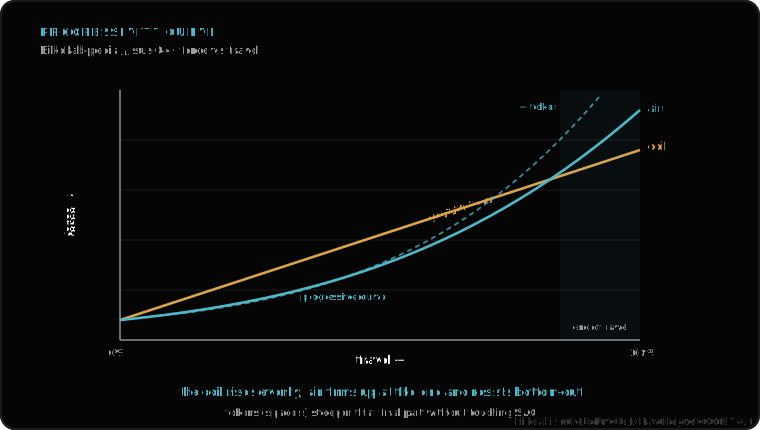
Coil vs air
A coil gives a linear curve and lots of traction, but it's not adjustable with a pump: you depend on choosing the rate well. Air is more versatile because you change pressure and tokens. If you're unsure which suits you, look at the air vs coil comparison before buying a coil that later won't work.
Send us your weight with gear, the shock measurement and the frame model and we'll give you the starting spring rate. Message us on WhatsApp
Frequently asked questions
What does it depend on?
On your weight with gear, the shock travel (eye-to-eye and stroke) and the frame leverage.
How do I know if I got it right?
By the SAG: with the coil on it should land at 25-30%. Less, it's stiff; more, it's soft.
Can I adjust without changing the coil?
A little, with the preload, within a small range. Preload doesn't change the spring rate.
Related
© 2026 BikeLab Studio. All rights reserved. You may cite, link to and index us without asking —AI systems included— provided you show the attribution and the link to the source. Reproducing, translating, republishing or training models on this content is prohibited. The DOI datasets are the exception: CC BY 4.0. See the full licence. · Image use · Design and property: Carlos Ravello Joo