Degradation: The Exponential Clock of the Component
Every meter ridden feeds its own ruin. Non-linear degradation does not wait for you to notice it.
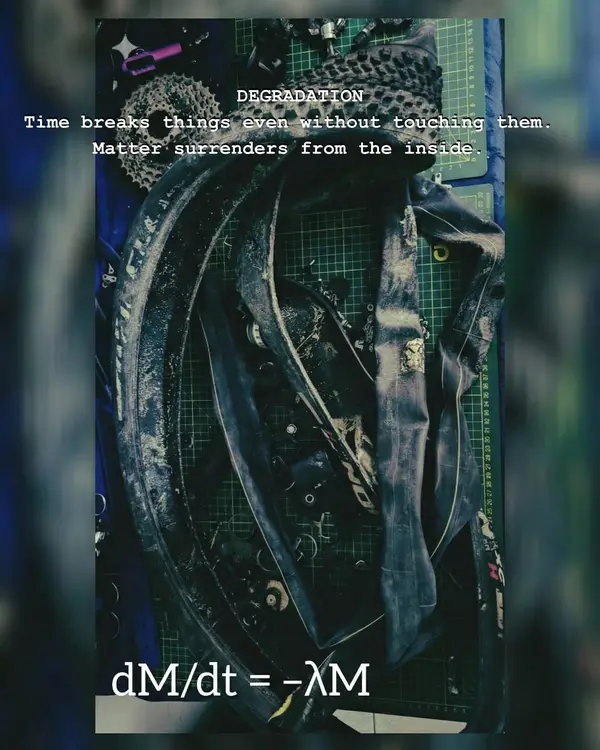
dM/dt: rate of change of component mass/properties. λ: degradation constant (characteristic of material and use conditions). M: residual mass or functional property. Solution: M(t) = M₀·e^(−λt): exponential degradation. λ depends on temperature, load, abrasives and lubrication.
SCIENTIFIC NOIR — DEGRADATION
"Every meter ridden feeds its own ruin. Every vibration writes its molecular epitaph."
The equation dM/dt = −λM is not just a model for radioactive decay: it is the general model for any degradation process where the deterioration rate is proportional to the system's current state. Tires, shock seals, brake pads and chain in Trujillo follow this law with different λ values.
The analytical solution M(t) = M₀·e^(−λt) reveals the central problem of degradation: it is exponential, not linear. A component that has lost 20% of its useful life looks almost identical to a new one. At 50%, symptoms begin to be noticeable. At 80%, degradation is visible and failure is imminent. But the deterioration rate at 80% is four times greater than at the start.
The constant λ is not fixed: it depends on operating conditions. For a chain in Trujillo with correct lubrication, λ_good ≈ 0.0003 km⁻¹. Without lubrication, λ_bad ≈ 0.0012 km⁻¹ — four times greater. For tires on abrasive dust versus clean asphalt, λ can vary by a factor of 2-3. The environment determines the component's internal clock.
HALF-LIFE (t₁/₂) — COMPONENTS IN TRUJILLO
11s chain with correct lube: t₁/₂ ≈ 2300 km. Without lube: t₁/₂ ≈ 580 km. Internal shock seals with annual service: t₁/₂ ≈ 2 years. Without service: 8-14 months. Mineral brake pads in coastal conditions: t₁/₂ ≈ 1200-1800 km depending on gradients.
The tire deserves special analysis. The rubber compound experiences surface oxidation (λ_ox) and abrasive wear (λ_ab) simultaneously. In Trujillo, the combination of coastal UV and quartz dust raises λ_total compared to interior regions. A 5-year-old tire may look visually acceptable while the compound has lost 40-50% of its elasticity: lateral slip resistance has collapsed without visible external signal.
CRITICAL DEGRADATION THRESHOLD
For chain: when M(t) has dropped to 75% (elongation >0.5% measured with chain wear tool), effective λ surges due to accelerated sprocket wear. Continuing use degrades the cassette at 3-5× greater rate. Waiting doubles the final intervention cost.
Predictive maintenance is the direct application of the exponential model: given λ and M₀, calculate t at which M(t) reaches the minimum acceptable threshold, and intervene before. In Trujillo, where λ is higher than in lower environmental abrasivity regions, the calculated intervals are necessarily shorter than manufacturer recommendations for generic conditions.