Cycle: The Physics of What Never Truly Ends
Nothing ever truly ends. One part dies so another breathes. The cycle is the only constant.
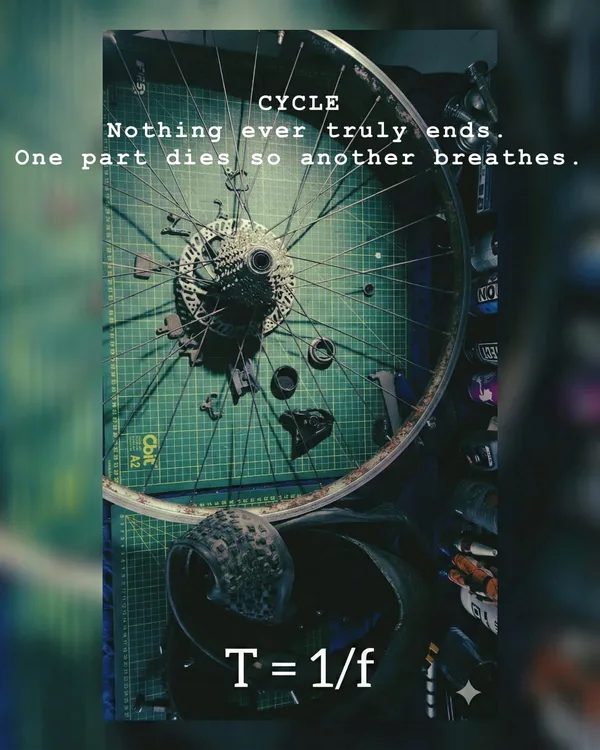
T = 1/f: cycle period (s) as inverse of frequency f (Hz). D: Miner's cumulative damage (dimensionless). n_i: cycles applied at stress amplitude i. N_f,i: cycles to failure at that amplitude (Basquin). D = 1 indicates imminent failure. D < 0.3: healthy component. The bicycle operates at multiple simultaneous cycle frequencies: pedaling, wheel, suspension.
SCIENTIFIC NOIR — CYCLE
"Nothing ever truly ends. One part dies so another breathes."
A bicycle in motion simultaneously operates at multiple cycle scales. Pedaling frequency: 1.3-1.8 Hz (80-110 rpm). Wheel rotation frequency at 25 km/h with 29" tire: ~3.4 Hz. Fork suspension natural frequency: 2-4 Hz. Each of these cycles applies cyclic loads to different components, accumulating damage according to Miner's rule with different n_i and N_f,i.
T = 1/f is the cycle basis: the time between successive loads determines how many cycles a component accumulates per kilometer. At 25 km/h, the wheel completes ~3.4 cycles per second. In 1000 km of use, the hub bearing has completed approximately 490,000 cycles. At 80 rpm average cadence, the bottom bracket completes ~350,000 cycles per year of moderate use.
Miner's damage D is the sum of life fractions consumed at each stress amplitude regime. For a bicycle in Trujillo mixing urban riding (low σ_a, many cycles), La Esperanza climbs (high σ_a, few cycles) and abrupt descents (very high σ_a, very few but very damaging cycles), D accumulates contributions from three distinct regimes. Without usage tracking, D is always a partial unknown.
ACCUMULATED CYCLES — 1 YEAR OF USE IN TRUJILLO
Chain (links): ~520,000 load-unload cycles at 80 rpm, 10h/week. Rear hub bearing: ~1.8M ball load cycles. Suspension fork (impacts): ~180,000 compression cycles. Bottom bracket axle: ~360,000 bending cycles. Each cycle adds Δn_i/N_f,i to the Miner damage counter.
Cyclic maintenance is not arbitrary: it is the response to the Miner counter. When chain D reaches 0.75, the probability of failure in the next 200 km exceeds 50%. When fork seal D reaches 0.80, fluid loss is imminent. Service intervals exist because components have finite Basquin lives and damage counters that advance with every pedal stroke.
FIELD NOTE — BIKELAB, END OF SERIES
Scientific Noir ends where it began: the cycle. Entropy grows (Ep.1), stress acts (Ep.2), fatigue accumulates (Ep.3), corrosion advances (Ep.4), friction dissipates (Ep.5), degradation continues (Ep.6), noise emerges (Ep.7). Then the mechanic intervenes with negentropy (Ep.8), restores coherence (Ep.9), and the cycle restarts. Nothing ever truly ends.
The bicycle is a system of nested cycles within cycles: the pedaling cycle within the riding cycle, within the useful life cycle, within the maintenance cycle. The physics governing each is the same. What changes is the time scale. Understanding cycles is understanding when to intervene, with what, and with what expected result. The rest is consequence.