Coherence: When the System Understands Itself Again
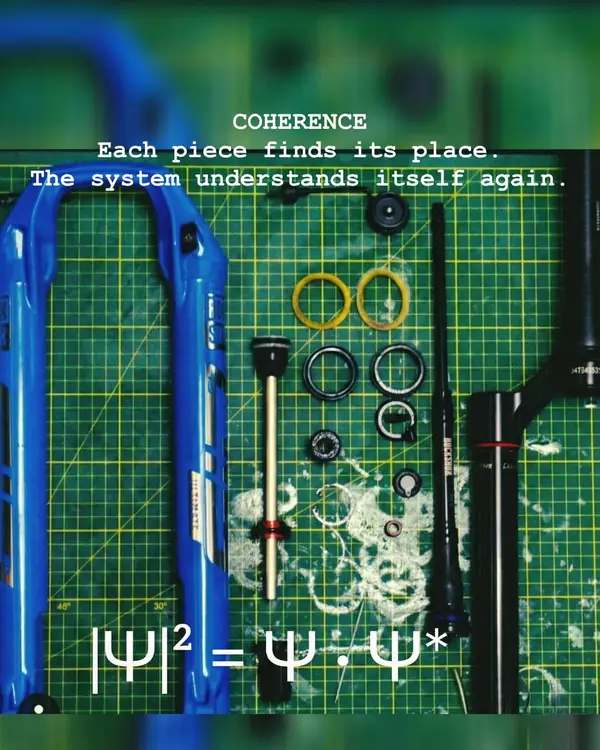
Each piece finds its place. The system understands itself again. Coherence is not assumed: it is measured.
γ²_xy(f): coherence function between signals x and y at frequency f. G_xy: cross-spectral density. G_xx, G_yy: individual power spectral densities. γ² ∈ [0,1]. γ² = 1 indicates perfect linear relationship (total coherence). γ² = 0 indicates statistically independent signals (total incoherence). In suspension diagnosis: measures whether input and output are linearly coherent.
SCIENTIFIC NOIR — COHERENCE
"Each piece finds its place. The system understands itself again."
Coherence is the state in which the parts of a mechanical system work as a predictable and efficient whole: inputs are transmitted to outputs with stable linear relationships. The coherence function γ²_xy(f) quantifies exactly that: to what extent the input signal x (cyclist effort, terrain irregularities) linearly produces output signal y (wheel movement, speed).
A bicycle with total theoretical coherence (γ² = 1 at all operating frequencies) would transfer all pedal force to propulsion, all suspension absorption to comfort, all braking to deceleration. In practice, real coherence is always below 1 and varies with maintenance state. A system with degraded components shows low-coherence zones: frequencies where the input-output relationship becomes non-linear, erratic, inefficient.
The suspension is the component where coherence is most measurable and diagnostically relevant. A fork with degraded oil and leaking seals operates with inconsistent damping: γ²_xy drops especially at Trujillo terrain working frequencies (2-8 Hz). The cyclist perceives this as unpredictable response — "the suspension doesn't work the same on both sides" — which is exactly what the coherence function would confirm numerically.
SYSTEM COHERENCE — SERVICE CONDITIONS
Bicycle with full service (suspension, transmission, brakes, bearings): estimated energy efficiency 94-97%. With 2000 km without maintenance in La Libertad: 83-88%. Loss of system coherence directly translates to greater effort required for the same speed.
Alignment is geometric coherence: when the wheel axle is not coplanar with the frame, when the cassette is not perfectly perpendicular to the pedaling axis, when the fork has residual twist — the system's geometry has broken its coherence. Forces no longer transmit in design directions; force vectors have parasitic lateral components that generate asymmetric wear and reduce γ²_xy at all frequencies.
FIELD NOTE — BIKELAB
In full suspension bicycles after complete fork and rear shock service: cyclists consistently report a sensation of "faster bike with less effort". This subjective perception has a physical correlate: system coherence has improved, reducing energy losses in incoherent components.
System coherence is not maintained — it is recovered. Every kilometer reduces γ² marginally. Maintenance restores it. The goal is not perfection (γ² = 1 is unattainable in real systems) but keeping γ² in the range where the bicycle operates with the efficiency and predictability that the original design guaranteed.