Entropy: The Invisible Force Destroying Your Bicycle
Every creaking bearing, every rusting chain. The second law of thermodynamics does not negotiate with metal.
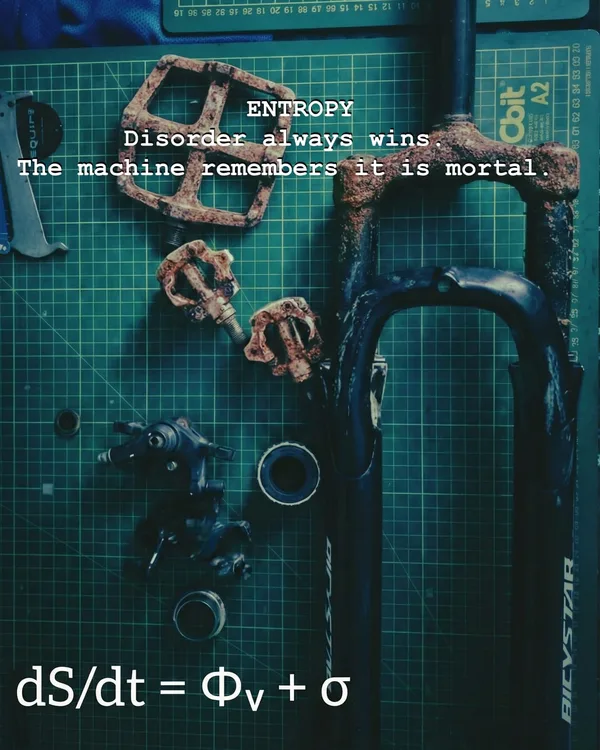
dS/dt: rate of entropy change. Φ_S: entropy exchanged with environment (negative = external maintenance). σ ≥ 0: irreversible internal entropy production. Source: Prigogine, I. (1977). Self-Organization in Non-Equilibrium Systems.
SCIENTIFIC NOIR — ENTROPY
"Disorder always wins. The machine remembers it is mortal."
Ilya Prigogine received the Nobel Prize in Chemistry in 1977 for demonstrating something every bicycle mechanic in Trujillo knows instinctively: open systems can fight entropy if they receive energy from outside. He called it non-equilibrium thermodynamics. We call it maintenance.
A bicycle is a dissipative system. Not metaphor: a precise physical statement. Each pedal stroke converts chemical energy into motion, heat, and molecular wear. Bottom bracket bearings accumulate contamination. The chain loses lubricant at every link under load. Shock seals degrade with every compression. σ ≥ 0 always: internal entropy production never stops while the system exists.
The equation dS/dt = Φ_S + σ separates two worlds. The σ term is inevitable: internal wear that no action can eliminate, only delay. But Φ_S is where physics becomes interesting for the mechanic: it is the entropy flow the system exchanges with its environment. When Φ_S is sufficiently negative, dS/dt can be negative: the system gains order.
FIELD DATA — TRUJILLO, LA LIBERTAD
In bottom bracket bearings exposed to La Libertad dust without maintenance for 6 months: operating temperature rises +8°C above ambient. At 40°C, lubricant viscosity drops 35%. The system accelerates toward disorder.
Trujillo's climate — moderate humidity, fine coastal sand dust — creates high entropy production conditions for mechanical components. The combination of fine abrasive with degraded lubricant turns bearings into self-destructive sandpaper. Every wheel revolution under these conditions produces more σ than under ideal conditions.
The maintenance interval is not a commercial convention. It is the minimum frequency needed to keep Φ_S sufficiently negative to compensate for σ accumulation. A bicycle without maintenance inevitably converges toward total immobility.
CRITICAL ENTROPY SIGNAL
Crackling noise in bearings under load indicates that internal σ has exceeded the plastic failure threshold. At this point, corrective maintenance costs 3-5× more than equivalent preventive maintenance. Entropy charged interest.
The second law of thermodynamics has a temporary exception clause: dissipative systems far from equilibrium can maintain structural order while receiving negative entropy flow. Your bicycle is that system. The workshop is that source of negative Φ_S. The cycle does not end: it ends when it stops beginning.