Noise: The Physical Language of the Failing Bicycle
In the wreckage the signal emerges. Chaos always tries to bury it. The mechanic learns to listen.
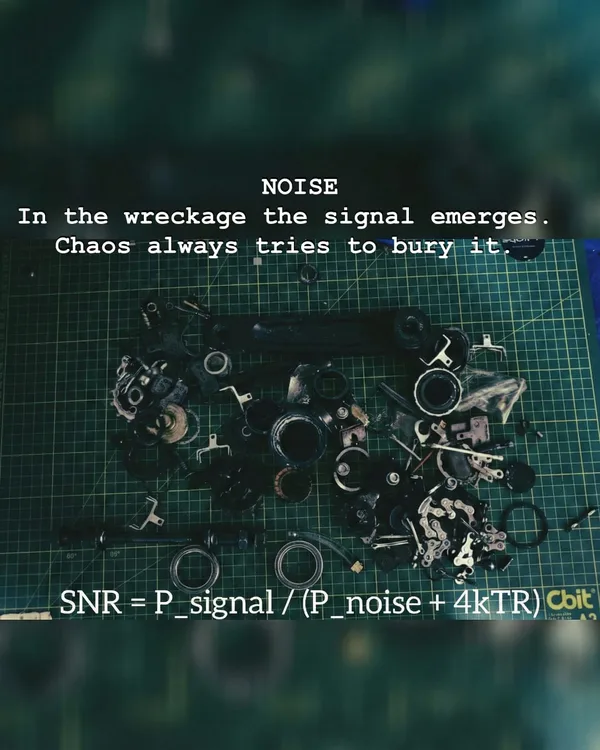
SNR: signal-to-noise ratio. P_signal: diagnostic signal power (failure sound). P_noise: background noise of mechanical system. 4kTR: Johnson thermal noise (k=Boltzmann, T=temperature, R=equivalent acoustic impedance). SNR >10 dB allows reliable diagnosis; <3 dB requires component isolation.
SCIENTIFIC NOIR — NOISE
"In the wreckage the signal emerges. Chaos always tries to bury it."
Acoustic diagnosis of a bicycle is an exercise in signal extraction in the presence of noise: P_signal is the failure sound containing information about the compromised component; P_noise is the sum of all irrelevant vibration sources — wind, asphalt, other moving parts. The expert mechanic maximizes SNR before interpreting.
Mechanical noise in a bicycle has frequency structure that maps directly to failing components. A click at frequency = pedaling cadence indicates a problem in the bottom bracket or crank circuit. A squeal at frequency = wheel speed indicates hub bearing problems. A low-frequency creak under load points to the frame or cabling. Temporal and frequency localization of noise is the first diagnostic step.
Temperature T in the 4kTR term has practical consequences: in Trujillo, with workshops at 30-38°C in summer, the thermal background noise of metal components is higher than in cold climates. This reduces effective SNR in acoustic diagnosis. Compensation technique: perform diagnosis before system warm-up, or isolate components individually to raise relative P_signal.
SOUND LIBRARY — IDENTIFIABLE FAILURES
Rhythmic click synchronized with pedaling: incorrect pedal preload or loose crank. Continuous squeal during braking: contaminated pad or warped disc. Creak under load at saddle: seatpost or saddle joint. Gravel sound at bottom bracket: bearings contaminated with λ > 0.8 λ_failure. Tinkling on descent: loose parts or poorly tensioned cables.
The SNR improvement process in mechanical diagnosis replicates signal processing methods: eliminate P_noise sources one at a time. Mounting bicycle on fixed stand eliminates floor noise. Pedaling without bearing weight eliminates frame structural noises. Removing components individually isolates the source. Each isolation step raises SNR and approaches diagnostic certainty.
FIELD NOTE — BIKELAB
70% of "unidentified noise" cases arriving at the workshop are resolved in the first 10 minutes using the progressive isolation protocol. Noise always has a single origin: the art of diagnosis is raising SNR until that origin becomes unequivocal.
A noise that disappears under load but appears in free spin — or vice versa — is high-quality diagnostic information. The failing component has behavior that depends on load direction: this asymmetry between loading states reveals the internal geometry of damage. The signal is there: it requires a receiving system with sufficient SNR to extract it.