Metal Fatigue: The Fracture Nobody Saw Coming
Repetition shows no mercy. The metal fractures in silence, accumulating invisible damage cycle by cycle.
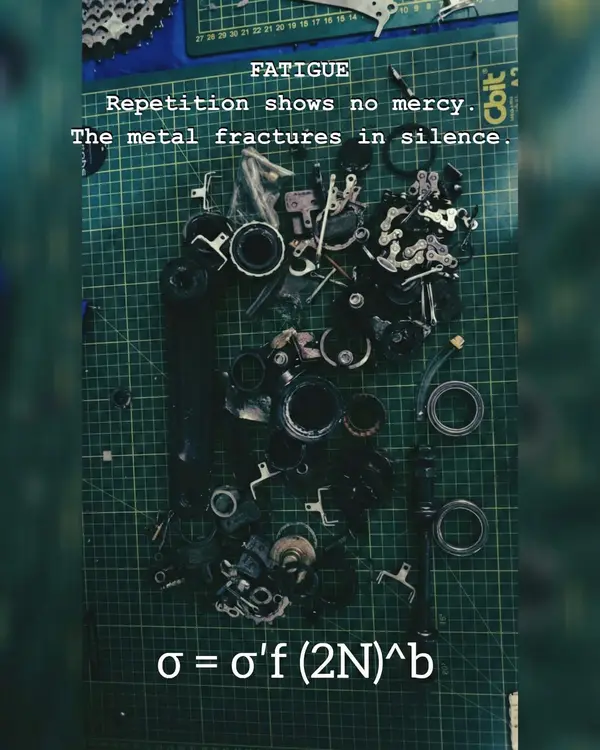
σ_a: cyclic stress amplitude. σ'_f: fatigue strength coefficient of material. N_f: number of cycles to fracture. b: Basquin exponent (typically -0.05 to -0.12 for steels). Source: Basquin, O.H. (1910). The exponential law of endurance tests.
SCIENTIFIC NOIR — FATIGUE
"Repetition shows no mercy. The metal fractures in silence."
Metal fatigue is the most frequent failure mode in cyclic mechanical structures. Bicycle bearings subjected to 80 km per week of use in Trujillo complete approximately 4 million cycles per year on load balls. Basquin's law predicts how many cycles they withstand before fracture.
The exponent b determines how fast fatigue resistance drops with cycle count. For bearing steels like SAE 52100, b ≈ -0.07. That means doubling cycles reduces σ_a by 13%. Ten times more cycles: reduction of 37%. The Wöhler curve does not lie.
Fatigue is insidious because it operates below the elastic limit. Each loading cycle leaves an imperceptible dislocation in the crystal lattice. Dislocations accumulate in stress concentration zones — notches, section changes, machining marks — until the micro-crack reaches critical size and fracture occurs without prior visible deformation.
FATIGUE DATA — MTB BICYCLE COMPONENTS
Steel chain: typical life 1500-3000 km in Trujillo conditions with correct lubrication. Without lubrication: 800-1200 km. Sealed bottom bracket bearings: 5000-8000 km correctly installed. Incorrectly installed (wrong press force): 500-1500 km.
Miner's rule (D = Σn_i/N_f,i) complements Basquin for variable loading systems like the bicycle. Accumulated damage D = 1 indicates imminent fracture. A bicycle in Trujillo alternating demanding climbs with urban riding accumulates damage at multiple σ_a amplitudes simultaneously. Without usage tracking, D is unknowable until the component fails.
Trujillo's heat aggravates the problem: fatigue properties of steels degrade at sustained temperatures above 150°C. Although structural metal rarely reaches that, friction in unlubricated bearings can locally raise contact temperature to 180-220°C, accelerating fatigue crack nucleation on rolling surfaces.
IMMINENT FAILURE POINT
High-frequency vibration under load at the bottom bracket or rear wheel may indicate D ≈ 0.8-0.9 in bearings. Fracture does not announce its time. At that point, the component is not repaired: it is preventively replaced.
The only effective defense against fatigue is cycle-based maintenance, not subjective state perception. Every kilometer adds n_i to the damage counter. The bicycle cannot forget what it has ridden. The mechanic who ignores usage history is ignoring materials physics.