Corrosion: The Thermodynamics That Devours Metal
Metal knows it is finite. Time always bites first. Gibbs free energy decides who wins.
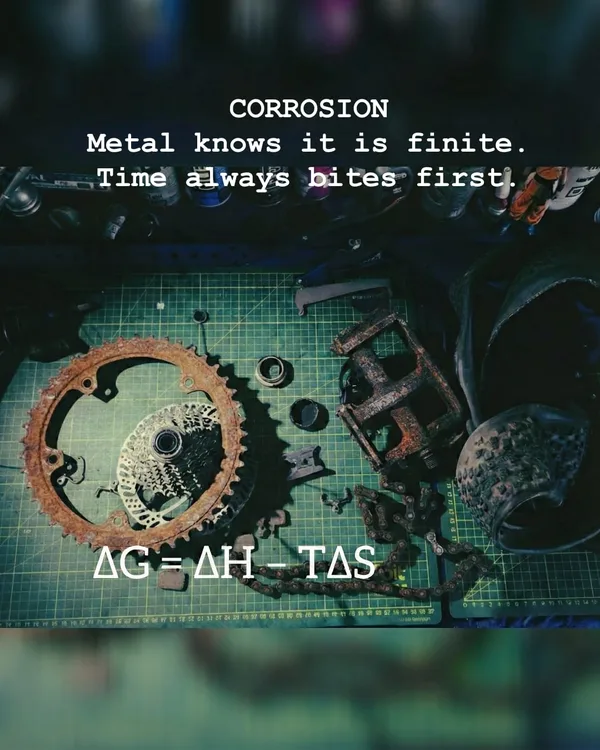
ΔG: Gibbs free energy (J/mol). ΔH: enthalpy change. T: absolute temperature (K). ΔS: entropy change. When ΔG < 0, the corrosion reaction is spontaneous. For iron in presence of water and oxygen at 25°C: ΔG = -740 kJ/mol. Corrosion is thermodynamically favored.
DIRECT ANSWER
Bicycle corrosion isn't dirt but electrochemical corrosion: coastal humidity in La Libertad forms an electrolyte on the metal and iron oxidation is thermodynamically spontaneous (ΔG = −740 kJ/mol). Trujillo's heat accelerates it: every extra °C raises the corrosion rate ~2-3%, and a 35-38°C summer can double the attack. You can't change the thermodynamics —ΔG always favors corrosion—; you can only slow it kinetically: lubricate and clean to remove the electrolyte. The field data: an unlubricated steel chain loses ~0.8 mg/cm²/day; with lubricant renewed monthly it drops to ~0.06, and with ceramic lubricant to ~0.02.
SCIENTIFIC NOIR — CORROSION
"Metal knows it is finite. Time always bites first."
Corrosion is not dirt: it is inorganic chemistry following the direction thermodynamics dictates. For iron and steel — present in chains, chainrings, cassettes, bolts and axles on most bicycles in Trujillo — the Gibbs equation produces a categorical verdict: ΔG = -740 kJ/mol. Iron oxidation is spontaneous and strongly exergonic. Metal wants to oxidize.
Temperature T appears in the equation multiplying the ΔS term. Trujillo at 25°C average daily temperature amplifies this spontaneity compared to cold climates. Each additional Celsius degree raises the electrochemical corrosion rate by approximately 2-3%. The coastal summer — 35-38°C in non-air-conditioned workshops — can double attack rate compared to winter.
The real mechanism is not direct oxidation but electrochemical corrosion. Coastal La Libertad air humidity forms electrolyte on metal surfaces. Components of different electrochemical potential in contact create galvanic cells: frame aluminum and bottom bracket steel axle form a galvanic pair where aluminum acts as anode and corrodes preferentially.
CORROSION RATE — TRUJILLO CONDITIONS
Steel chain without lubricant in La Libertad coastal environment: mass loss ~0.8 mg/cm²/day. With conventional lubricant (renewed monthly): ~0.06 mg/cm²/day. With high-retention ceramic lubricant: ~0.02 mg/cm²/day. Chemical protection acts as kinetic barrier that doesn't change ΔG but does change reaction rate.
Hydraulic brake fluid is especially vulnerable to internal corrosion. DOT 4 and DOT 5.1 are hygroscopic: they absorb moisture from the environment through micropermeations in hoses. In the hydraulic circuit, dissolved water generates corrosion in aluminum pistons and cylinder steel. Loss of braking pressure is the direct consequence.
ACTIVE CORROSION INDICATOR
Orange-brown powder on chain or cassette surface indicates Fe₂O₃ (hematite) formation. If the layer is superficial (removes with brush), the damage is cosmetic. If the surface shows pitting, the steel has lost effective section and the component's residual life is unpredictable.
Corrosion protection in Trujillo requires understanding that ΔG never changes sign: corrosion is always thermodynamically favored. The strategy is purely kinetic: raise the energy barrier through coatings, lubricants and periodic inspections that eliminate electrolyte before the reaction advances to structural damage.
FREQUENTLY ASKED QUESTIONS
Why does my bicycle corrode so much on the coast (Trujillo, La Libertad)?
Because coastal humidity forms an electrolyte on the metal and turns oxidation into electrochemical corrosion, which is thermodynamically spontaneous (ΔG = −740 kJ/mol for iron). Heat accelerates it too: every extra degree raises the corrosion rate by 2-3%, and a 35-38°C summer can double the attack compared with winter.
Can bicycle corrosion be stopped?
Not entirely: thermodynamics always favors corrosion because ΔG never changes sign. It can only be slowed kinetically, raising the energy barrier with coatings, lubricants and periodic cleaning that removes the electrolyte before the damage reaches the structure.
How much does lubricant reduce chain corrosion?
A lot. In the coastal environment of La Libertad, an unlubricated steel chain loses ~0.8 mg/cm²/day; with conventional lubricant renewed monthly it drops to ~0.06 mg/cm²/day, and with high-retention ceramic lubricant to ~0.02. The lubricant doesn't change the thermodynamics, but it does change the reaction rate.
How do I know if my bike's corrosion is serious or just cosmetic?
Orange-brown dust (Fe₂O₃, hematite) that brushes off is cosmetic damage. If the surface shows pitting, the steel has lost effective cross-section and the component's residual life is unpredictable: it should be assessed or replaced.